
IPv4 vs IPv6: Key Differences Explained Simply
You open your router's settings to fix a slow video call and find two switches: one for IPv4, one for IPv6. Nobody told you what either does, and the label "dual stack" is not helping.
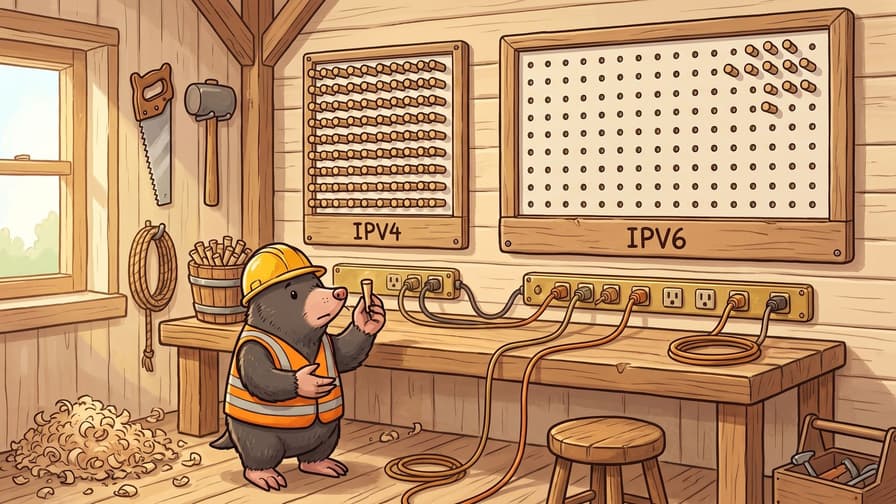
IPv4 and IPv6 are two versions of the Internet Protocol, the addressing system every device online uses. The main difference is size: IPv4 addresses are 32-bit, about 4.3 billion in total, while IPv6 addresses are 128-bit, enough that nobody expects to run out. Most of the rest, from NAT to header layout, traces back to that.
This guide covers the differences, where adoption stands in late 2026, what scarcity does to IPv4 prices, how websites treat IPv6 ranges, and what it means for proxies. Example addresses come from documentation ranges (192.0.2.0/24 and 2001:db8::/32).
IPv4 vs IPv6 in one minute
- Size. IPv4 uses 32 bits per address. IPv6 uses 128 bits.
- Format. IPv4 is dotted decimal:
192.0.2.1. IPv6 is hexadecimal groups separated by colons:2001:db8::1. - Why IPv6 exists. IPv4 ran out of addresses to hand out.
- Today. Both run side by side. Most modern devices and networks speak both and pick whichever works.
Differences between IPv4 and IPv6
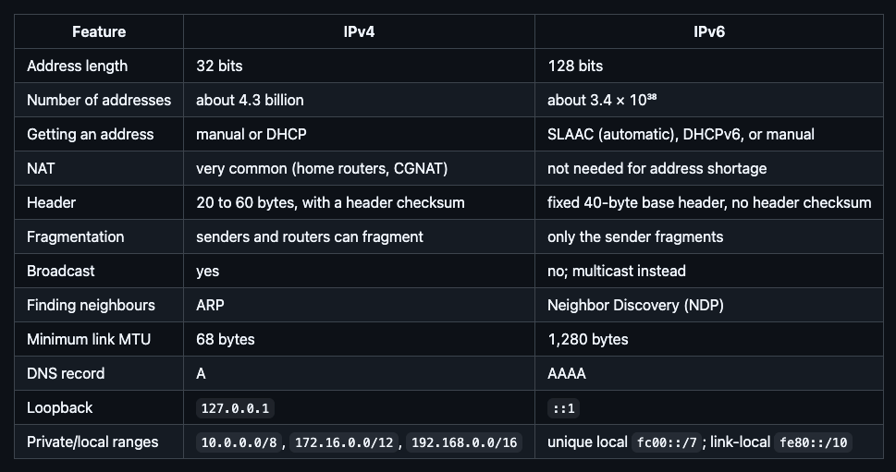
The two are not directly compatible. An IPv4-only device cannot talk to an IPv6-only one without a translation layer in between.
Reading an IPv6 address
An address is eight groups of four hex digits. Two rules shorten it: drop leading zeros in each group, and replace one run of all-zero groups with ::. So 2001:0db8:0000:0000:0000:0000:0000:0001 becomes 2001:db8::1. In URLs, wrap it in brackets so the colons do not clash with the port: http://[2001:db8::1]:8080/.
Where adoption stands in 2026
IPv6 has crossed a symbolic line, but not a practical one. The answer depends on who is measuring:
- Google reported that access to its services over native IPv6 exceeded 50% for the first time, at 50.10% on 28 March 2026, as the Internet Society's Pulse blog noted. That is an aggregate for Google traffic on a single day, not a steady level, and it hides large differences between countries. Press coverage put the day-to-day range nearer 45 to 50%.
- Pulse's average across all its IPv6 data sources was 43% in that same piece.
- Websites lag users. In a Common Crawl measurement dated 16 March 2026, 36.9% of the 100,000 most-linked hosts were fully reachable over IPv6, and a further 1.2% published AAAA records that failed the reachability check.
Each tracker measures something different: Google counts users reaching its own services, APNIC measures through ad delivery, and Cloudflare Radar counts requests to its network. Check the live pages (Google, APNIC Labs, Cloudflare Radar) rather than trusting a number quoted in an article, including this one.
The practical reading: roughly half of users can reach you over IPv6, but only about a third of top sites can be reached back. That gap is why dual stack stays the default.
Why IPv4 still works: NAT, CGNAT and translation
IPv4 did not stop working when the central pool ran out in 2011. It stretched:
- NAT. Your router shares one public IPv4 address between every device at home.
- CGNAT. Carrier-grade NAT does the same one level up: your ISP shares one public address between many customers, so unrelated people can look like the same visitor to a website.
- Trading. Addresses are bought, sold and leased between organisations.
- Translation. IPv6-only networks reach IPv4 sites through DNS64 and NAT64: DNS64 synthesizes an AAAA record from an A record, and NAT64 maps the IPv6 connection to an IPv4 one. Apple has required App Store apps to work on IPv6-only networks since 1 June 2016, and warns developers not to hard-code IPv4 literals or build NAT64 addresses by hand.
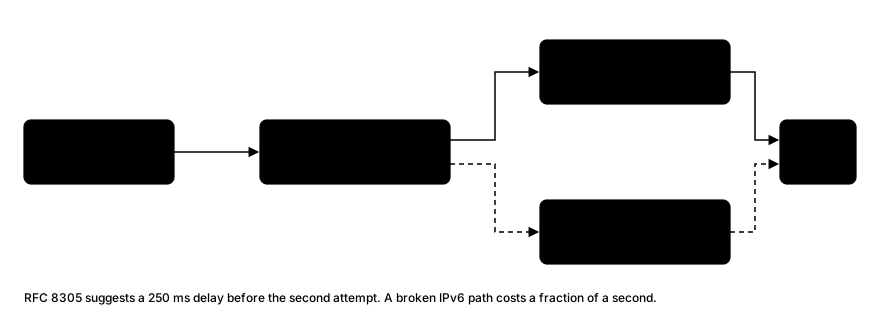
- Dual stack and Happy Eyeballs. When a hostname has both
AAAAandArecords, browsers try IPv6 first and start IPv4 shortly after, using whichever connects first. RFC 8305 suggests a 250 ms delay before the second attempt.
What an IPv4 address costs
Scarcity has a price. IPv4Center, a broker, reported in its H1 2026 market review (published on CircleID) an average of $20.04 per IP across 596 transactions, down 35.7% from H1 2025, with an estimated lease rate of $0.5859 per IP per month. Other brokers quote different ranges for a /24, and every source here sells addresses, so treat these as indicative.
The cost lands on anyone who needs many distinct, clean IPv4 addresses. It is also one reason a pool of IPv4 exits costs more to run than a pool of IPv6 ones.
Is IPv6 faster or more secure?
Faster: not inherently. IPv6 can avoid NAT hops and sometimes takes a different route, so some connections are quicker and others are not. Measure your own path.
More secure: not automatically. IPsec is available and optional in both. And with IPv6 every device can have a globally routable address, so you lose NAT's accidental shelter. Firewalls matter more, not less.
How to check which one you use
- Look at your addresses. Windows:
ipconfig. macOS:ifconfig | grep inet6. Linux:ip -6 addr show scope global(no output means no global IPv6). A line startingfe80::is link-local and does not mean you have public IPv6. Global addresses usually start with2or3. - Test the path. An address does not prove traffic leaves over IPv6. Use a test page such as test-ipv6.com, or force each protocol with curl:
curl -4 https://ip.evomi.com/s
curl -6 https://ip.evomi.com/s
If curl -6 fails with a network error, your connection has no working IPv6 route. That is common and not a fault. Whether a given service answers over IPv6 also varies by day and network, so no single site is your verdict.
For most people the advice is simple: leave both on. Turn IPv6 off only briefly to diagnose a specific problem, and report a broken IPv6 route to your ISP rather than living with it.
How sites treat IPv6 ranges
This is where the protocols differ most for anyone running automated traffic.
With IPv4, a single address is the unit of reputation and rate limiting. With IPv6, one address is nearly meaningless, because a single connection typically gets a whole prefix (a /64 for a home network is the usual allocation, and larger blocks like /56 or /48 are common). Per-address limits would never catch anything, so operators key limits on a prefix instead.
Practice varies, and I could not find a standard threshold from the IETF or the registries. Public operator guidance, such as engineered.at's article on IPv6 rate limiting, describes hierarchical limits that start at the address, then escalate to the /64, then to /56 or /48. The same writing warns that /64 blocking can over-block large legitimate tenants, much as blocking an IPv4 CGNAT address can hit thousands of innocent users. Treat the specifics as site policy, not a rule.
What this means for you:
- Your effective identity is the prefix, not the address. Rotating through addresses inside one
/64looks like one client. - Shared history cuts both ways. A prefix shared by many tenants inherits one abuser's reputation; see IP fraud scores and why checkers disagree.
- Polite behaviour is what scales. Obey
robots.txt, honour rate limits, and slow down on429responses whichever protocol you use.
IPv4, IPv6 and proxies
Two questions get mixed up:
- Which IP version do you use to reach the proxy? That follows your DNS and network.
- Which version does the website see? That is the proxy's exit IP, set by the provider's network.
They can differ: connect over IPv4 and exit over IPv6, or the reverse. SOCKS5 carries IPv6 destinations (RFC 1928), and an HTTP proxy takes a bracketed target: CONNECT [2001:db8::1]:443. If a site is IPv6-only, the exit must support IPv6.
Given the prefix-based treatment above, an IPv6 exit is only as good as how its prefix is shared and allocated, and a site that is IPv4-only is only reachable through an IPv4 exit. Which versions a provider supports is provider-specific, so check its documentation. For the basics, see what a proxy server is, the SOCKS5 proxy guide and the proxy ports and formats guide.
Mistakes That Waste Time
- Quoting one adoption number. Google, APNIC and Cloudflare measure different things; say which one and when.
- Assuming IPv6 means more anonymity. A whole prefix is easier to rate-limit as a unit, not harder.
- Disabling IPv6 permanently to fix one hang instead of finding the broken route.
- Treating NAT as a firewall. It never was one.
Wrapping Up
IPv4 vs IPv6 comes down to address size, 32 bits against 128. In 2026 IPv6 carries about half of Google's traffic on a good day, while only about a third of top sites answer on it, so dual stack with Happy Eyeballs remains the sane default. For proxies, remember two things: the IP version you connect over is separate from the exit the site sees, and sites judge IPv6 by prefix, not by single address.