
Definition
What Is a Residential Proxy?
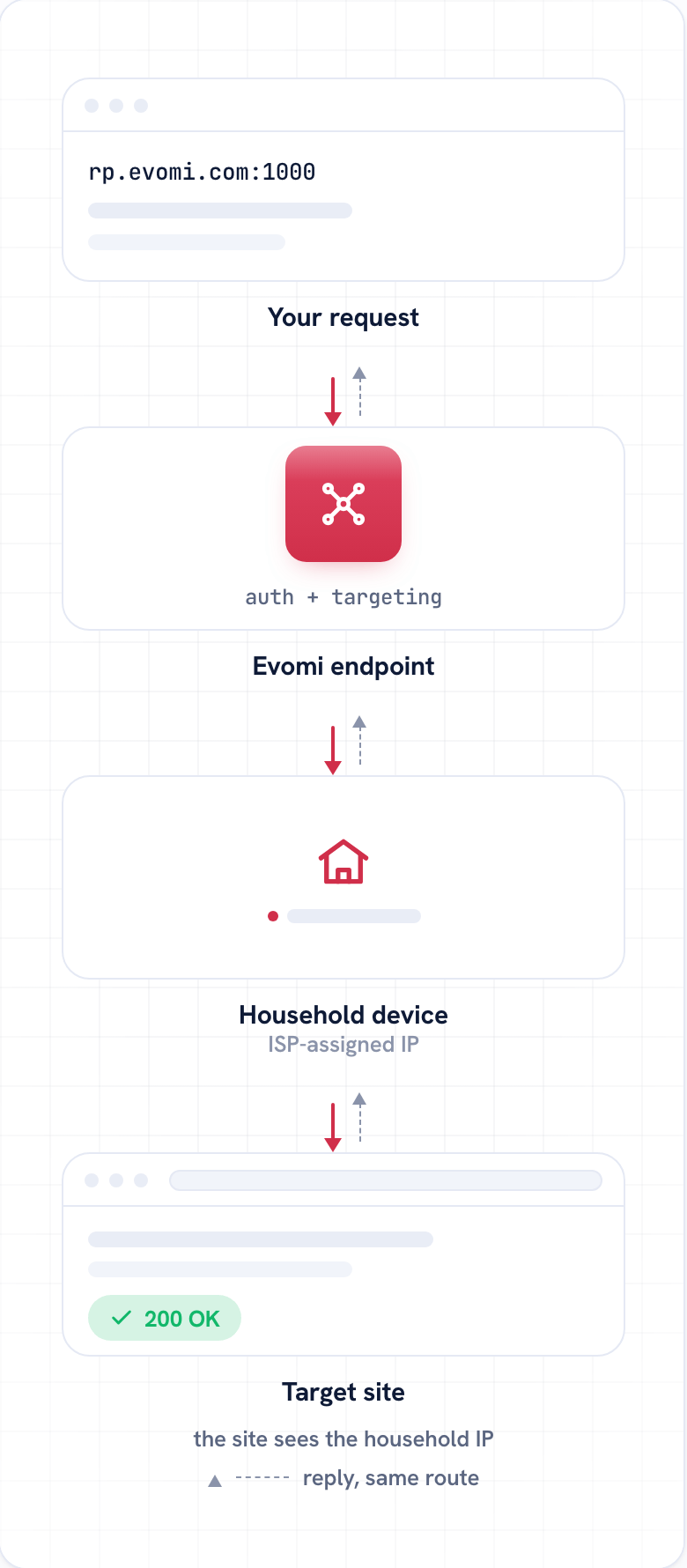
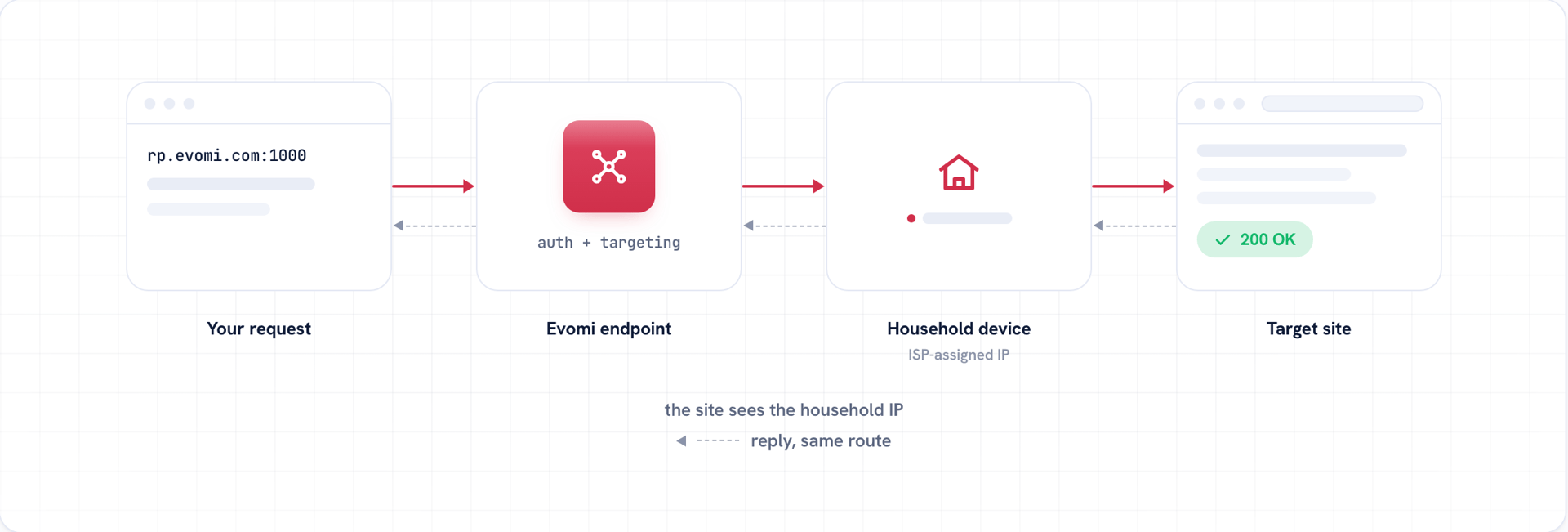
A residential proxy routes your request through a real household device on a consumer internet connection, so the site you are calling sees an IP address that an ordinary internet provider handed to a home — not an address in a datacenter range. The reply travels back the same way, and to the target the request looks like an ordinary visitor in that location.
How it works
How do residential proxies work?
Nothing about your request changes. The only difference is who owns the address it arrives from.
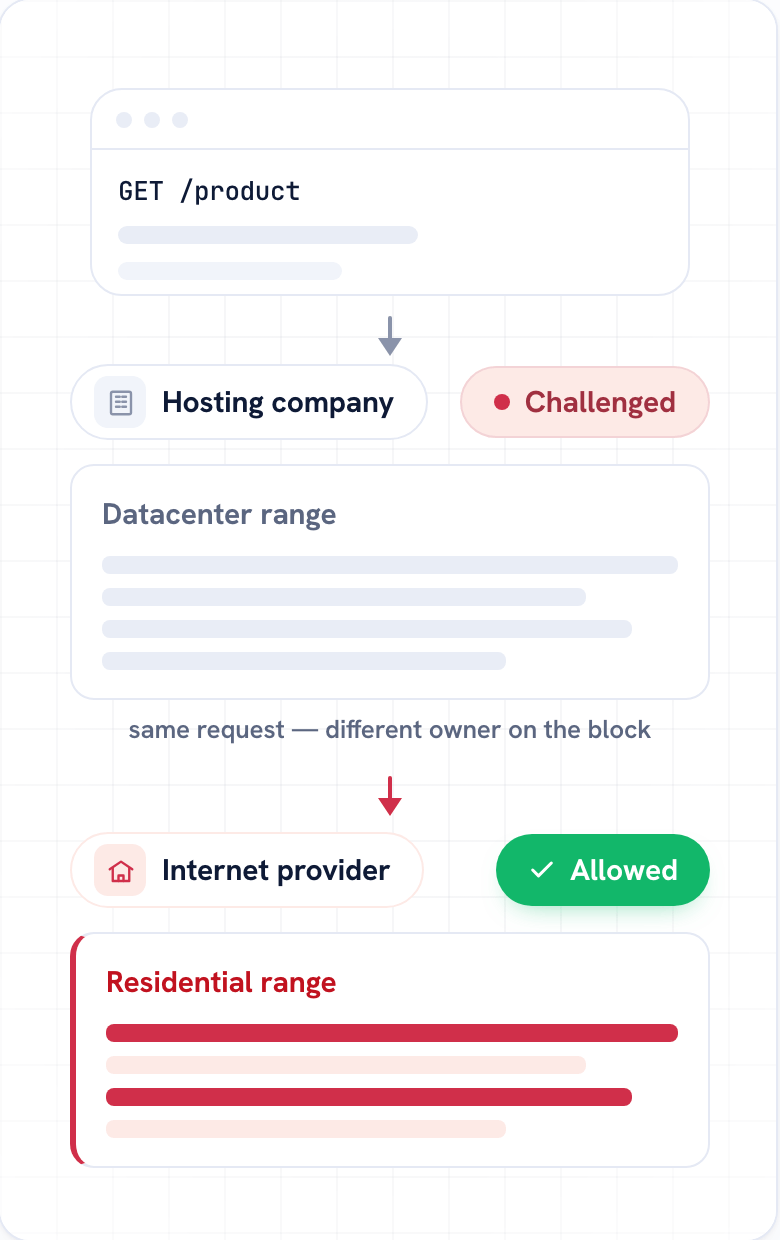
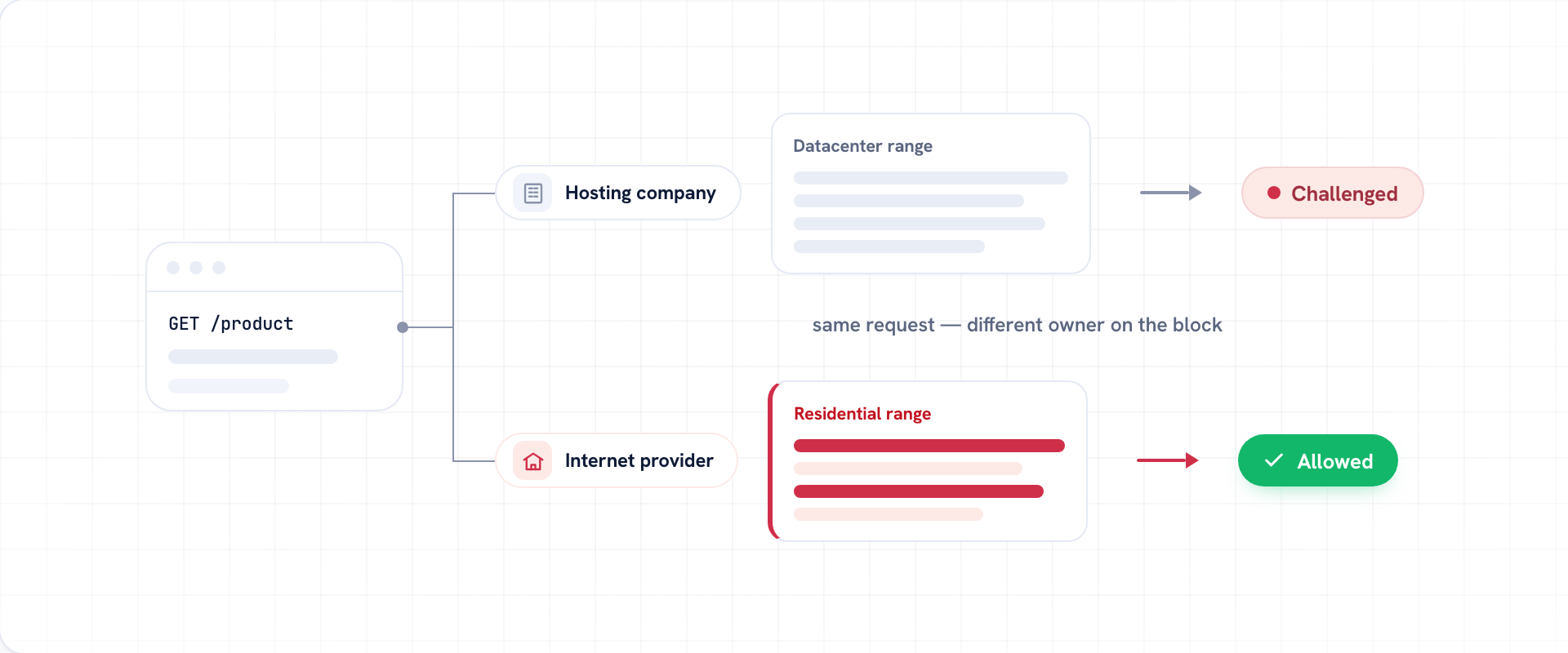
A site that cares who is visiting sorts addresses by who owns the block they sit in. A datacenter range belongs to a hosting company and can be filtered wholesale at no cost to the site, while a residential range belongs to an ISP whose subscribers are the site’s own audience. Filtering those costs the site real visitors, which is why residential addresses get through where datacenter addresses are challenged — and why the traffic is worth paying for by the gigabyte.
Evomi’s Core Residential pool is 54M+ IPs, ethically sourced from a global network of volunteer nodes, reachable in 195+ countries. The documented figures for the network are an average response time under 0.5 seconds and a 99.95% connection success rate. Every request leaves from a new IP unless you explicitly ask for one to be held.
The connection, in short
- Endpoint
- rp.evomi.com, one host for every country
- Ports
- HTTP 1000, HTTPS 1001, SOCKS5 1002
- Auth
- Username and password, with targeting in the password field
- Rotation
- A new IP on every request unless a session key holds one
Compared with the rest
Residential vs datacenter vs ISP vs mobile
Residential is the middle of the range on both price and trust, which is why it is the default.
| Type | Where the IPs come from | Price | Best for |
|---|---|---|---|
| Residential | Real household devices on consumer lines | from $0.49/GB | The default for volume collection: cheapest per GB of the residential family, and trusted enough for most targets |
| Static residential (ISP) | Residential-registered IPs hosted on premium ASNs | from $1.00/IP | Holding one address for weeks, with bandwidth billed per IP instead of per GB |
| Mobile | Real devices on 3G/4G/5G carrier networks | from $2.20/GB | Targets that treat a carrier IP as their most credible visitor: social platforms, app traffic, mobile ad checks |
| Datacenter | Server IPs in datacenter ranges | from $0.30/GB | Speed and cost on targets that do not check where the address lives |


Use cases
What are residential proxies used for?
The jobs where the address a target sees decides whether the answer you get back is the real one.
Ad verification
A placement only counts as delivered if it renders for the audience it was bought for. Loading it from a household IP in that country shows you the creative a real visitor is served, rather than the one an ad network hands to an address it can see is a server.
Adtech verificationPrice and market research
Retailers show different prices, currencies and stock by region, and something else again to an address that looks like a datacenter. Collecting from residential IPs in each market is what makes the figures you compare the figures a shopper there sees.
Market researchSEO and SERP monitoring
Search results are personalised by location down to the city, so a rank tracked from one datacenter is a rank in one place only. A residential IP in the market you care about returns the page your customers are looking at.
Search engine monitoringLocalisation and QA testing
Geo-gated pricing, translated copy and region-locked banners are the hardest things to test from your own office. Routing a browser through a residential IP in the target country puts you in the same bucket as the visitors the page was built for.
Localised content testingPublic data collection at volume
Long runs across public pages are where the address matters most. Rotation spreads the requests over many household IPs instead of sending all of them from one, which is why bulk collection is the job residential proxies are bought for most often.
Data extractionSocial platforms and account work
Social networks judge an address harder than most sites do, and they treat a mobile carrier IP as their most credible visitor. Residential is enough for research and monitoring; for managing accounts, mobile usually earns its higher price.
Social media marketingResidential is the sensible default for all of these. The table above is the honest check on that: where a target never looks at who owns the address, a cheaper type does the same job. Where an AI agent is the one deciding what to collect, the Evomi MCP server hands it the same rotation and geo-targeting controls as tools it can call itself.
Rotation
Rotating vs sticky sessions: which do you need?
Every option below is a key you append to the password field — no second endpoint and no plan upgrade.
Rotate every request
no parameterThe default. Each request leaves from a different residential IP, which is what you want when you are collecting many pages from one target and no page depends on the last.
Sticky session
session-<6–10 chars>Holds one IP across requests and is tuned for overall success rate, so it may move you to keep the connection working. Add lifetime-<minutes> to say how long it holds: 30 minutes by default, up to 1440 — a full 24 hours. Ask for more than the maximum and the request returns a 412.
Hard session
hardsession-<6–10 chars>Same format, opposite priority: it keeps the exact IP for as long as the network can, and ignores lifetime. Use it where a logged-in session breaks the moment the address changes.
Legality and sourcing
Are residential proxies legal?
Generally yes — and where the addresses came from matters more than the technology does.
Using a proxy is not unlawful in itself in most places, and a residential IP does not change that. What decides the answer is the use and the jurisdiction: reading public pages, checking your own campaigns and testing your own site sit a long way from getting past a login you were never given. Evomi’s Acceptable Use Policy prohibits illegal activity and email-related use outright, and for your own case and country the honest answer is to take legal advice rather than ours.
Every IP in the pool is shared by someone who chose to share it, through an app that says so, and who is paid for doing it. Their privacy runs the other way too: no customer of ours can see a node’s browsing or device data. Sourcing is the part of this business that is easiest to do quietly and badly, which is why ours is written down rather than asserted.
How we source every IPWhere the IPs come from
- Consent
- Volunteer nodes only, opted in and paid for their bandwidth
- Oversight
- Member of the Ethical Web Data Collection Initiative
- Operation
- Swiss-operated, ISO 27001 certified and SOC 2 Type II compliant
- Limits
- The Acceptable Use Policy bars illegal and email-related use
Use one
Ready to route through a residential IP?
Plans, geo-targeting and the trial sit on the residential proxies product page. Create an account to start a trial on your own targets — that is the handoff, not a detour through a pricing index.
FAQs
Residential proxy questions, answered
What is a residential proxy?
A residential proxy sends your request through a real household device on a consumer internet connection, so the site you are calling sees an IP address an ordinary internet provider assigned to a home rather than an address in a datacenter range. Because that address belongs to an ISP whose subscribers are the site’s own audience, filtering it costs the site real visitors — which is why residential IPs get through where datacenter IPs are challenged.
How do residential proxies work?
You point your client at one endpoint, rp.evomi.com, and authenticate with a username and password. Evomi picks an IP from the pool, forwards your request from it and returns the response. Targeting and session keys are appended to the password, so switching country or holding an IP is a change to a string rather than a change of endpoint. By default every request leaves from a different IP.
How are the residential IPs sourced?
From a global network of volunteer nodes that opt in to share their connection, which is what the "ethically sourced" claim on this page refers to. Evomi is ISO 27001 certified, SOC 2 Type II compliant and Swiss-operated, and the sourcing is the reason the pool holds up: addresses that were taken without consent are the ones targets recognise and block first.
Residential vs datacenter proxies: which should I use?
Datacenter is cheaper and faster and makes sense wherever the target does not check who owns the address. Residential costs more per GB because the addresses belong to real ISP subscribers, which is what gets you past the checks that stop datacenter ranges. The honest test is to try the cheap option first and move up only on the targets that block it.
What is the difference between residential and static residential (ISP) proxies?
Rotating residential draws from a pool of household devices and is billed per gigabyte, so the address changes and the cost follows your traffic. Static residential is one residential-registered IP hosted on a premium network, billed per IP with unlimited bandwidth, so the address stays yours for as long as you keep it. Pick static when an account or a session has to keep seeing the same address for weeks.
Residential vs mobile proxies: when is mobile worth the price?
Residential is the default for volume work — far cheaper per GB, and enough trust for most targets. Mobile earns its higher price on the targets that treat a carrier address as their most credible visitor, such as social platforms, mobile app endpoints and ad checks on mobile inventory.
Do you offer rotating and sticky sessions?
Both, at no extra cost. Rotation is the default: a new IP on every request. A session key holds one IP for 30 minutes by default, and the lifetime parameter extends that to 1440 minutes — a full 24 hours. A hardsession key holds the same address for as long as the network allows instead. Concurrent sessions are unlimited on every plan.
Are free residential proxies worth using?
Rarely. A free residential IP is either an address whose owner never agreed to carry your traffic, or one so heavily reused that targets already recognise it — and sharing the list makes both worse. A paid pool of consenting nodes is the thing being bought, not the bandwidth.
Are residential proxies legal?
Proxies are generally legal, but the legality depends on how they are used and on the jurisdiction. Evomi prohibits illegal activity and email-related use under its Acceptable Use Policy, and we recommend taking legal advice for your own use case and location.