The Ethics Problem the Industry Can’t Ignore - PIA Proxy Down?

The Scraper
Proxy Fundamentals
The proxy market is currently facing its most severe reckoning to date. In January 2026, a massive disruption sent shockwaves through the industry as major provider, including ABCProxy, PIA S5 Proxy, Lunaproxy, and PyProxy, saw their networks decimated and domains seized.
These weren't just random outages. Following investigations by the Google Threat Intelligence Group into the IPIDEA network, legal and technical actions were taken to dismantle infrastructure built on non-consensual sourcing.
In an instant, entire proxy pools vanished. Customers were left scrambling. And the industry was forced to answer the question it has avoided for too long: Where do residential IPs actually come from?
Residential IPs Are Not a Commodity
A residential IP belongs to a real household, a real device, and a real person. When a provider advertises tens of millions of IPs at "too good to be true" prices, that supply often originates from "black box" SDKs hidden in free apps or VPNs.
There are only two sustainable models for the future:
Explicit, informed user consent.
Legally structured peer participation programs.
Anything else is a liability. As we saw with the recent collapse of PIA S5 and LunaProxy, networks built on murky sourcing don’t slowly degrade, they are forcibly shut down. When they go, your business infrastructure goes with them.
The Illusion of Infinite Scale
For years, the industry optimized for one metric: Pool Size. But scale without transparency is fragile. Massive IP pools built without clear sourcing documentation carry structural risks that lead to:
Regulatory Seizure: Direct intervention by tech giants and law enforcement.
ASN Blacklisting: Entire ranges being flagged due to association with botnets.
Reputation Collapse: Your data requests being treated as malicious traffic.
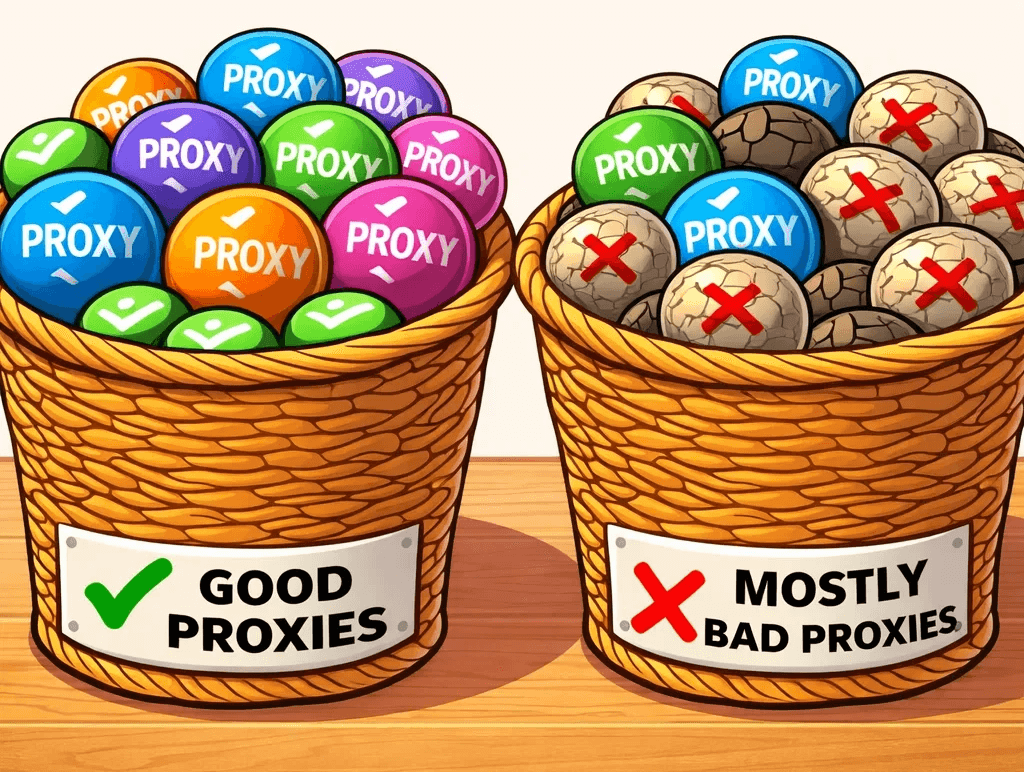
The 2026 Reality: Cheap bandwidth feels like a win until your provider’s dashboard returns a 404 because their C2 domains were seized overnight.
Ethics Is Infrastructure
Most teams evaluate proxies on success rates and price per GB. Very few evaluate the Consent Model.
Ethical sourcing isn’t a moral talking point, it’s operational stability. If your data pipeline depends on a network that cannot withstand a legal audit, your business has a hidden fragility. This is why the industry is shifting toward a "Compliance-First" model.
The Evomi Alternative: Trust as a Feature
As networks like ABCProxy, LunaProxy and PyProxy fail, forward-thinking enterprises are migrating to providers like Evomi.
Instead of chasing unverified IP counts, Evomi has built its reputation on:
Verified Sourcing: Explicit, consensual participation from every node in the pool.
EWDCI Membership: Adherence to the Ethical Web Data Collection Initiative standards.
Swiss Quality Standards: High-integrity infrastructure that prioritizes IP reputation over raw volume.
Defensible Data: Providing users with an audit trail that proves their data was collected through legitimate, non-malicious channels.
The Bottom Line
The collapse of the IPIDEA-affiliated brands is not just a news cycle; it is a permanent shift in how the web works. Infrastructure built on unclear sourcing is infrastructure at risk.
In 2026, the strongest proxy networks won't be the largest. They will be the ones that can explain exactly how their IPs are sourced, and prove it.
Scale is easy. Trust is harder. And in this new era, trust is the only thing that survives.

Author
The Scraper
Engineer and Webscraping Specialist
About Author
The Scraper is a software engineer and web scraping specialist, focused on building production-grade data extraction systems. His work centers on large-scale crawling, anti-bot evasion, proxy infrastructure, and browser automation. He writes about real-world scraping failures, silent data corruption, and systems that operate at scale.