


The proxy market has more product categories than it used to, and the naming is inconsistent enough to cause genuine confusion. "ISP proxies", "static residential", "premium residential", "rotating residential", these labels mean different things to different providers, and using the wrong type for a use case is a common and expensive mistake.
This is the definitive comparison between the two most frequently confused types: ISP proxies (also called static residential) and rotating residential proxies. Both have legitimate use cases. Neither is universally better. The choice depends on what you're actually building.
The Technical Difference
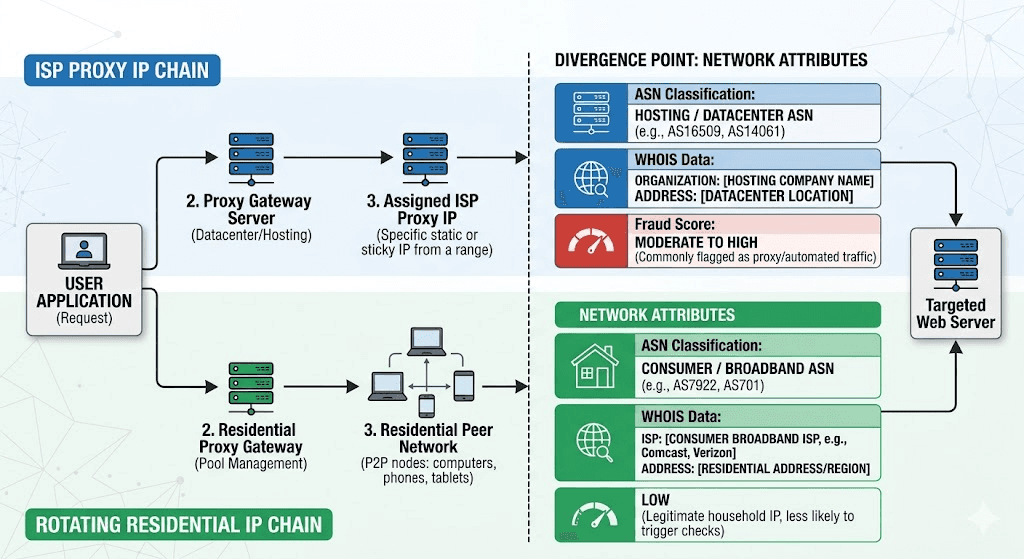
Rotating residential proxies are IPs assigned to real end-user devices, home routers, mobile devices, desktop computers, whose owners have opted into a proxy network. When you request a proxy, you're routed through one of these real consumer devices. The IP changes with each session (or on a fixed interval). The key property: the IP is registered to a consumer ISP (Comcast, BT, Vodafone), in a residential address block.
ISP proxies (static residential) are IPs hosted in data centers but assigned to the IP ranges of residential ISPs. The IPs look residential, the ASN, the WHOIS record, the IP classification databases all say "residential ISP." But the physical hardware is in a data center. And critically: these IPs are static. You get the same IP every time until you explicitly rotate it.
Same ISP classification. Fundamentally different architecture. Different performance profile.
Speed: ISP Proxies Win Clearly
Datacenter hardware on high-bandwidth connections versus consumer broadband through a home router. The speed difference is significant and consistent.
Metric | Rotating Residential | ISP Proxy |
|---|---|---|
Typical latency | 80–250ms | 10–50ms |
Bandwidth per IP | 5–50 Mbps | 100–1000 Mbps |
Latency variance | High | Low |
Connection stability | Variable | High |
The residential proxy's path includes at least two additional network hops (your client → proxy server → residential device → target), plus whatever the consumer's home network contributes in latency and jitter. ISP proxies take the datacenter-direct path, adding only one controlled hop.
For high-volume, latency-sensitive scraping, price monitoring that needs to complete in minutes, not hours, this gap matters significantly.
Detection Risk: Rotating Residential Wins (Usually)
Here's where the trade-off inverts. Rotating residential IPs are real consumer IPs, their fraud score history comes from the actual browsing behavior of real people. Even a large fraud score database has limited coverage of individual consumer IPs that rotate frequently.
ISP proxies, despite the residential classification, have a different behavioral profile:
Static IPs accumulate reputation. An ISP proxy IP that's been used for scraping by previous customers has a history. Sophisticated bot detection systems, Kasada, Shape Security, DataDome's advanced configurations, track IPs over time. A static IP that sent 10,000 requests last Tuesday is flagged, regardless of its ASN classification.
ISP proxy ranges are identifiable. The major ISP proxy providers operate in identifiable IP blocks. Detection vendors maintain lists of known ISP proxy ranges, similar to how they maintain datacenter IP lists. The classification advantage erodes against sophisticated detection.
Rotating residential IPs are moving targets. If your IP rotates every request, there's no accumulated behavioral history per IP to flag. Each request arrives from a fresh IP with an unblemished history.
The detection table:
Detection System | Rotating Residential | ISP Proxy |
|---|---|---|
IP reputation databases | Low risk | Medium risk (static IPs accumulate) |
ASN/ISP classification | Very low risk | Low risk |
Behavioral analysis | Neutral (IP-level) | Medium risk (history builds) |
Kasada / Shape | Medium risk (IP quality dependent) | Medium-high risk |
Stickiness: ISP Proxies Win Clearly
This is where ISP proxies have a decisive advantage for specific use cases: session continuity.
Any workflow that requires maintaining a session across multiple requests needs a consistent IP. Logging into an account, maintaining a cookie-bearing session, completing a multi-step form, holding an authenticated API session, all of these break if the IP changes mid-session.
Rotating residential proxies offer session stickiness via session IDs (encoded in the proxy username), but the duration is limited, typically 10–30 minutes, and the IP can change if the underlying residential device disconnects. ISP proxies give you the same IP indefinitely. You can hold a logged-in session for hours, days, or weeks with no IP change.
Use cases where ISP proxies are clearly better:
Account-based scraping — logged-in sessions on social platforms, e-commerce accounts, SaaS tools
Shopping cart and checkout flows — multi-step processes requiring consistent session state
Authenticated API access — API tokens tied to IP
Sneaker/limited drop purchasing — long-held sessions on retailer sites during high-traffic events
The Use Case Matrix
Use Case | Recommended Type | Reason |
|---|---|---|
High-volume product catalog scraping | Rotating Residential | Volume needs IP diversity; no session requirement |
Cloudflare / DataDome bypass (no login) | Rotating Residential | Fresh IPs reduce block rate |
Account-based social scraping | ISP Proxy | Session persistence required |
Kasada / Shape-protected targets | Premium Residential | IP quality is the primary lever |
Sneaker / limited release bots | ISP Proxy | Long session hold required |
Travel price monitoring | Rotating Residential | Geo-diversity, no session needed |
Authenticated e-commerce scraping | ISP Proxy | Login state must persist |
AI training data collection at scale | Rotating Residential | Volume and IP diversity matter more |
Ad verification / geo-checks | ISP Proxy | Stable IP needed for repeated verification |
Evomi's Offering Across the Spectrum
Evomi's static residential (ISP) proxies provide persistent residential-classified IPs on datacenter infrastructure, the right tool when session continuity matters. Evomi's rotating residential proxies (54M+ IPs, 195+ countries) are the right tool for volume scraping where IP freshness and geographic diversity matter more than consistency.
Both are ethically sourced and maintain clean fraud score profiles. The correct choice depends on your session requirements, not the brand.
As a practical test: if your scraping workflow requires cookies to persist across requests to the same domain, start by asking whether you need those cookies to persist across IP changes. If yes, you need ISP proxies or sticky sessions. If no, rotating residential is likely the better fit.
You can test both with Evomi's free trial and benchmark against your specific targets before committing.
The Common Mistake
The most common mistake: choosing ISP proxies because they're faster and assuming they're "better." Speed is one variable. The detection resistance trade-off bites hard on targets with sophisticated bot protection.
The second most common mistake: using rotating residential proxies for an account-based workflow, watching cookies invalidate every 10 minutes, and spending days debugging what's actually a proxy architecture mismatch.
Match the proxy type to the session requirements. Everything else follows.