
What Your IP Reveals: ASN, Reputation & How Geolocation Databases Work


The Scraper
Proxy Fundamentals
Your scraper opens a TCP connection. The TLS handshake hasn't finished, no User-Agent has been sent, no cookie, nothing. And the target site already knows roughly who you are, whether you're a home connection or a server in a rack, whether your address has misbehaved before, and what country and city it thinks you're sitting in.
All of that comes from one thing: the source IP on the packets. Everything else, headers, fingerprints, behavior, is a second layer of scrutiny that only matters if the first layer doesn't already flag you. This is the dossier a site can build before you say a word, and it explains the most common scraping outcome of all: a datacenter IP with flawless headers still getting a 403, while a "messier" residential IP loads the page fine.
Let's go through the dossier, field by field.
The IP → Owner Chain
An IP address isn't anonymous. Every public IP belongs to a block that was handed out, on the record, to some organization.
The chain works like this:
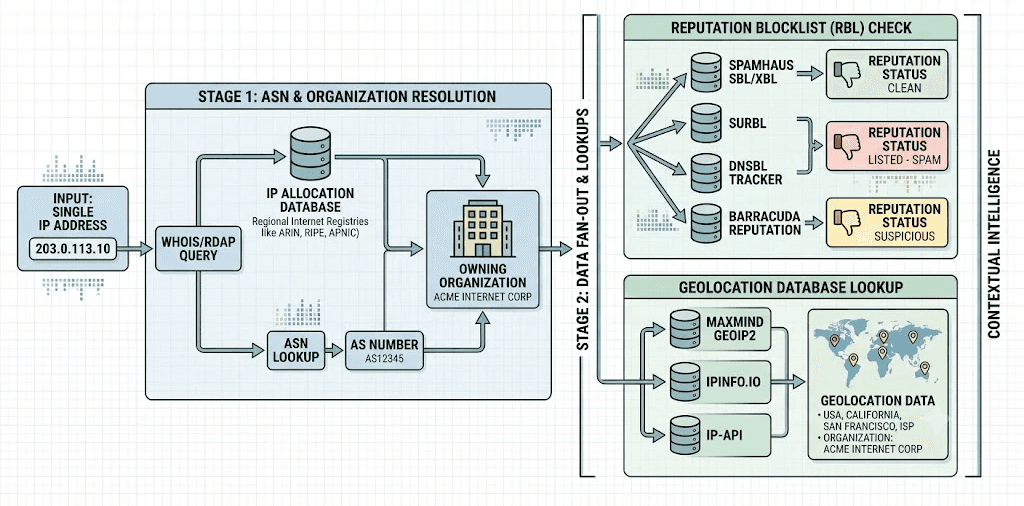
IP → ASN. An Autonomous System Number is the identifier for a network operator, an ISP, a cloud provider, a university. AS16509 is Amazon, AS7922 is Comcast, AS14061 is DigitalOcean. Routing on the internet happens between ASNs, so every routable IP maps to exactly one originating AS at any moment. This mapping is public; it's how packets find their way.
ASN → organization. The Regional Internet Registries (ARIN, RIPE, APNIC, LACNIC, AFRINIC) keep WHOIS/RDAP records assigning IP ranges to the orgs that hold them. Look up an IP and you get the netblock, the owning org name, the abuse contact, and the AS.
So with two cheap lookups, a target turns 52.x.x.x into "AS16509, Amazon, a cloud netblock." An anti-bot system reads that and reasons: real human visitors browse from Comcast, Vodafone, Orange, eyeball networks. They do not browse from inside an AWS region. A request whose ASN belongs to a hosting provider is, by default, a server pretending to be a person. That's not proof of abuse, but it's a strong prior, and it's the root cause of "datacenter IPs get blocked." Whole ASNs get treated as suspicious before any other signal is examined.
IP Reputation
ASN tells a site what kind of network you're on. Reputation tells it whether this specific address has a history.
Reputation is built from several inputs that get blended into a score:
Public blocklists. Spamhaus, various DNSBLs, and abuse feeds publish IPs seen sending spam, hosting malware, or running scrapers. These are queryable in milliseconds.
Prior-abuse observations. Large CDNs and anti-bot vendors see traffic across millions of sites. If your exit IP hammered someone else's login endpoint last week, that's logged against the IP, not against you.
Shared-IP contamination. This is the killer for cheap proxy pools. If hundreds of people route through the same exit IP and any of them misbehave, the IP's reputation drops for everyone on it. You inherit your neighbors' sins. CGNAT (more below) creates the same effect for legitimate mobile users, which is why scoring is fuzzy rather than binary.
Score decay. Reputation isn't permanent. A flagged IP that goes quiet usually recovers over days to weeks as the bad events age out. Scores are time-weighted: recent behavior counts far more than old behavior.
This is why a "clean pool" is worth paying for. It's not marketing, it's the difference between an exit IP with no recent abuse events and one that's been on a public blocklist for a month.
How Geolocation Databases Actually Work
When a site says you're in Frankfurt, it didn't measure where you are. It looked you up in a database. The big ones, MaxMind GeoIP2, IP2Location, IPinfo, and others, build their location guesses from a mix of:
Registration data. The RIR records say which org holds a block and where that org is registered. Useful, but the registration country is often just the ISP's HQ, not where the IP is used.
Latency triangulation. Measure round-trip time from many known-location probes to an IP and you can bound where it physically is. Good for region, rough for city.
User-submitted and app signals. When devices report GPS-tagged locations alongside their current IP (via apps, Wi-Fi positioning, etc.), providers correlate that to refine IP→location at city level.
ISP feeds. Some ISPs share their own assignment data, which is the most accurate source, when it exists.
The important takeaway for scraping: these databases are guesses, and they disagree. Run the same IP through three providers and you can get three cities. They also lag. When an ISP reassigns a block from Madrid to Lisbon, the databases might take weeks to catch up, so an IP that physically serves Portugal still geolocates to Spain.
For geo-targeted scraping the consequence is concrete: the "location" of your proxy exit is whatever the target's geolocation database says it is, which may differ from where the IP truly is and from what your provider advertised. If you're scraping localized pricing, the page you get is keyed to the target's view of your IP, not the ground truth. Test it; don't assume.
IP Type Classification
Beyond ASN, services explicitly classify IPs into types, and this label is often the single most decisive signal:
Datacenter. Owned by hosting/cloud ASNs. Cheap, fast, and the first thing aggressive sites block.
Residential. Assigned by a consumer ISP to a home connection. Reads as a real person. Highest trust, slower, more expensive.
Mobile. Assigned by a cellular carrier, often behind CGNAT (Carrier-Grade NAT), where thousands of real users share one public IP. That makes mobile IPs both hard to block (collateral damage on real customers) and noisy in reputation terms.
Hosting/VPN/proxy. Dedicated detection services maintain lists of known VPN endpoints, public proxies, and Tor exits, and flag IPs whose behavior or registration smells like infrastructure rather than an eyeball.
A site combining "datacenter ASN" + "flagged as hosting" + "no clean reputation" has three independent reasons to challenge you before reading a header.
What You Can and Can't Change
Here's the uncomfortable part: you cannot change the facts about an IP. You can't make AS16509 read as Comcast, you can't un-flag a blocklisted address by sending nicer headers, and you can't talk a geolocation database out of its guess. The IP's dossier is fixed.
What you can do is choose a different IP:
Pick the right type. If a target challenges datacenter ranges, you need residential or mobile exits. No amount of header tuning substitutes for the ASN being an eyeball network.
Avoid flagged ranges. A clean residential pool, like Evomi's, gives you exits without recent abuse history, you're not inheriting a stranger's reputation.
Match geo to your other signals. This is the part people miss. If your IP geolocates to Germany, your
Accept-Languageshould plausibly includede, your timezone (if you run a browser) should beEurope/Berlin, and the locale you request should line up. An IP in one country with headers screaming another country is an easy inconsistency to flag.
The job isn't to disguise an IP. It's to start from an IP whose honest facts already fit the request you're trying to make.
Inspect Your Own IP's Footprint
Before debugging headers, look at what your exit actually reveals. RDAP (the structured successor to WHOIS) gives you ASN and org straight from the registry, and IP-info services add a type classification. Here's a minimal, dependency-light check:
import requests def ip_footprint(ip: str | None = None): # ipinfo.io returns org/ASN + a geo guess; no token needed for light use info = requests.get(f"https://ipinfo.io/{ip or ''}/json", timeout=10).json() target_ip = info.get("ip") # RDAP straight from the registry for the authoritative org/netblock rdap = requests.get(f"https://rdap.org/ip/{target_ip}", timeout=10).json() print(f"IP: {target_ip}") print(f"Org/ASN: {info.get('org')}") # e.g. 'AS16509 Amazon.com, Inc.' print(f"Geo (DB): {info.get('city')}, {info.get('country')}") print(f"Netblock: {rdap.get('handle')} — {rdap.get('name')}") ip_footprint() # your own exit; pass an IP string to inspect a proxy exit
Run this through each proxy exit you plan to use. If the org line says a hosting provider, expect friction. If the geo disagrees with what your provider promised, your geo-targeting will too. Treat any single service as one opinion, cross-check the type classification across a couple of providers before trusting it.
Mistakes That Waste Time
Perfecting headers on a datacenter IP. A flawless Chrome 148 fingerprint on an AWS-owned IP is still an AWS-owned IP. Fix the IP first; the headers are the second checkpoint, not the first.
Trusting a geolocation database as ground truth. It's a lagging guess that other databases contradict. Verify the geo the target seesby actually requesting a localized page, not by reading your provider's dashboard.
Mismatching IP-geo and
Accept-Language. A Brazilian IP sendingen-USonly, or a French IP with aAmerica/New_Yorkbrowser timezone, is a free inconsistency for any detector. Make the IP's implied location and your stated locale agree.
Wrapping Up
A target learns more from your IP alone than from everything you deliberately send. The two facts that decide most outcomes are the ASN/type (is this an eyeball network or a server?) and the reputation (has this address misbehaved recently?). You can't edit those facts, so the real lever is choosing a better IP: residential or mobile when the target rejects datacenter ranges, a clean pool to dodge inherited abuse history, and a geo that's consistent with the rest of your request. Inspect your exit's footprint before you tune anything else, because if the dossier is wrong, no header will save it.

Your scraper opens a TCP connection. The TLS handshake hasn't finished, no User-Agent has been sent, no cookie, nothing. And the target site already knows roughly who you are, whether you're a home connection or a server in a rack, whether your address has misbehaved before, and what country and city it thinks you're sitting in.
All of that comes from one thing: the source IP on the packets. Everything else, headers, fingerprints, behavior, is a second layer of scrutiny that only matters if the first layer doesn't already flag you. This is the dossier a site can build before you say a word, and it explains the most common scraping outcome of all: a datacenter IP with flawless headers still getting a 403, while a "messier" residential IP loads the page fine.
Let's go through the dossier, field by field.

The IP → Owner Chain
An IP address isn't anonymous. Every public IP belongs to a block that was handed out, on the record, to some organization.
The chain works like this:
IP → ASN. An Autonomous System Number is the identifier for a network operator, an ISP, a cloud provider, a university. AS16509 is Amazon, AS7922 is Comcast, AS14061 is DigitalOcean. Routing on the internet happens between ASNs, so every routable IP maps to exactly one originating AS at any moment. This mapping is public; it's how packets find their way.
ASN → organization. The Regional Internet Registries (ARIN, RIPE, APNIC, LACNIC, AFRINIC) keep WHOIS/RDAP records assigning IP ranges to the orgs that hold them. Look up an IP and you get the netblock, the owning org name, the abuse contact, and the AS.
So with two cheap lookups, a target turns 52.x.x.x into "AS16509, Amazon, a cloud netblock." An anti-bot system reads that and reasons: real human visitors browse from Comcast, Vodafone, Orange, eyeball networks. They do not browse from inside an AWS region. A request whose ASN belongs to a hosting provider is, by default, a server pretending to be a person. That's not proof of abuse, but it's a strong prior, and it's the root cause of "datacenter IPs get blocked." Whole ASNs get treated as suspicious before any other signal is examined.
IP Reputation
ASN tells a site what kind of network you're on. Reputation tells it whether this specific address has a history.
Reputation is built from several inputs that get blended into a score:
Public blocklists. Spamhaus, various DNSBLs, and abuse feeds publish IPs seen sending spam, hosting malware, or running scrapers. These are queryable in milliseconds.
Prior-abuse observations. Large CDNs and anti-bot vendors see traffic across millions of sites. If your exit IP hammered someone else's login endpoint last week, that's logged against the IP, not against you.
Shared-IP contamination. This is the killer for cheap proxy pools. If hundreds of people route through the same exit IP and any of them misbehave, the IP's reputation drops for everyone on it. You inherit your neighbors' sins. CGNAT (more below) creates the same effect for legitimate mobile users, which is why scoring is fuzzy rather than binary.
Score decay. Reputation isn't permanent. A flagged IP that goes quiet usually recovers over days to weeks as the bad events age out. Scores are time-weighted: recent behavior counts far more than old behavior.
This is why a "clean pool" is worth paying for. It's not marketing, it's the difference between an exit IP with no recent abuse events and one that's been on a public blocklist for a month.
How Geolocation Databases Actually Work
When a site says you're in Frankfurt, it didn't measure where you are. It looked you up in a database. The big ones, MaxMind GeoIP2, IP2Location, IPinfo, and others, build their location guesses from a mix of:
Registration data. The RIR records say which org holds a block and where that org is registered. Useful, but the registration country is often just the ISP's HQ, not where the IP is used.
Latency triangulation. Measure round-trip time from many known-location probes to an IP and you can bound where it physically is. Good for region, rough for city.
User-submitted and app signals. When devices report GPS-tagged locations alongside their current IP (via apps, Wi-Fi positioning, etc.), providers correlate that to refine IP→location at city level.
ISP feeds. Some ISPs share their own assignment data, which is the most accurate source, when it exists.
The important takeaway for scraping: these databases are guesses, and they disagree. Run the same IP through three providers and you can get three cities. They also lag. When an ISP reassigns a block from Madrid to Lisbon, the databases might take weeks to catch up, so an IP that physically serves Portugal still geolocates to Spain.
For geo-targeted scraping the consequence is concrete: the "location" of your proxy exit is whatever the target's geolocation database says it is, which may differ from where the IP truly is and from what your provider advertised. If you're scraping localized pricing, the page you get is keyed to the target's view of your IP, not the ground truth. Test it; don't assume.
IP Type Classification
Beyond ASN, services explicitly classify IPs into types, and this label is often the single most decisive signal:
Datacenter. Owned by hosting/cloud ASNs. Cheap, fast, and the first thing aggressive sites block.
Residential. Assigned by a consumer ISP to a home connection. Reads as a real person. Highest trust, slower, more expensive.
Mobile. Assigned by a cellular carrier, often behind CGNAT (Carrier-Grade NAT), where thousands of real users share one public IP. That makes mobile IPs both hard to block (collateral damage on real customers) and noisy in reputation terms.
Hosting/VPN/proxy. Dedicated detection services maintain lists of known VPN endpoints, public proxies, and Tor exits, and flag IPs whose behavior or registration smells like infrastructure rather than an eyeball.
A site combining "datacenter ASN" + "flagged as hosting" + "no clean reputation" has three independent reasons to challenge you before reading a header.
What You Can and Can't Change
Here's the uncomfortable part: you cannot change the facts about an IP. You can't make AS16509 read as Comcast, you can't un-flag a blocklisted address by sending nicer headers, and you can't talk a geolocation database out of its guess. The IP's dossier is fixed.
What you can do is choose a different IP:
Pick the right type. If a target challenges datacenter ranges, you need residential or mobile exits. No amount of header tuning substitutes for the ASN being an eyeball network.
Avoid flagged ranges. A clean residential pool, like Evomi's, gives you exits without recent abuse history, you're not inheriting a stranger's reputation.
Match geo to your other signals. This is the part people miss. If your IP geolocates to Germany, your
Accept-Languageshould plausibly includede, your timezone (if you run a browser) should beEurope/Berlin, and the locale you request should line up. An IP in one country with headers screaming another country is an easy inconsistency to flag.
The job isn't to disguise an IP. It's to start from an IP whose honest facts already fit the request you're trying to make.
Inspect Your Own IP's Footprint
Before debugging headers, look at what your exit actually reveals. RDAP (the structured successor to WHOIS) gives you ASN and org straight from the registry, and IP-info services add a type classification. Here's a minimal, dependency-light check:
import requests def ip_footprint(ip: str | None = None): # ipinfo.io returns org/ASN + a geo guess; no token needed for light use info = requests.get(f"https://ipinfo.io/{ip or ''}/json", timeout=10).json() target_ip = info.get("ip") # RDAP straight from the registry for the authoritative org/netblock rdap = requests.get(f"https://rdap.org/ip/{target_ip}", timeout=10).json() print(f"IP: {target_ip}") print(f"Org/ASN: {info.get('org')}") # e.g. 'AS16509 Amazon.com, Inc.' print(f"Geo (DB): {info.get('city')}, {info.get('country')}") print(f"Netblock: {rdap.get('handle')} — {rdap.get('name')}") ip_footprint() # your own exit; pass an IP string to inspect a proxy exit
Run this through each proxy exit you plan to use. If the org line says a hosting provider, expect friction. If the geo disagrees with what your provider promised, your geo-targeting will too. Treat any single service as one opinion, cross-check the type classification across a couple of providers before trusting it.
Mistakes That Waste Time
Perfecting headers on a datacenter IP. A flawless Chrome 148 fingerprint on an AWS-owned IP is still an AWS-owned IP. Fix the IP first; the headers are the second checkpoint, not the first.
Trusting a geolocation database as ground truth. It's a lagging guess that other databases contradict. Verify the geo the target seesby actually requesting a localized page, not by reading your provider's dashboard.
Mismatching IP-geo and
Accept-Language. A Brazilian IP sendingen-USonly, or a French IP with aAmerica/New_Yorkbrowser timezone, is a free inconsistency for any detector. Make the IP's implied location and your stated locale agree.
Wrapping Up
A target learns more from your IP alone than from everything you deliberately send. The two facts that decide most outcomes are the ASN/type (is this an eyeball network or a server?) and the reputation (has this address misbehaved recently?). You can't edit those facts, so the real lever is choosing a better IP: residential or mobile when the target rejects datacenter ranges, a clean pool to dodge inherited abuse history, and a geo that's consistent with the rest of your request. Inspect your exit's footprint before you tune anything else, because if the dossier is wrong, no header will save it.
Your scraper opens a TCP connection. The TLS handshake hasn't finished, no User-Agent has been sent, no cookie, nothing. And the target site already knows roughly who you are, whether you're a home connection or a server in a rack, whether your address has misbehaved before, and what country and city it thinks you're sitting in.
All of that comes from one thing: the source IP on the packets. Everything else, headers, fingerprints, behavior, is a second layer of scrutiny that only matters if the first layer doesn't already flag you. This is the dossier a site can build before you say a word, and it explains the most common scraping outcome of all: a datacenter IP with flawless headers still getting a 403, while a "messier" residential IP loads the page fine.
Let's go through the dossier, field by field.

The IP → Owner Chain
An IP address isn't anonymous. Every public IP belongs to a block that was handed out, on the record, to some organization.
The chain works like this:
IP → ASN. An Autonomous System Number is the identifier for a network operator, an ISP, a cloud provider, a university. AS16509 is Amazon, AS7922 is Comcast, AS14061 is DigitalOcean. Routing on the internet happens between ASNs, so every routable IP maps to exactly one originating AS at any moment. This mapping is public; it's how packets find their way.
ASN → organization. The Regional Internet Registries (ARIN, RIPE, APNIC, LACNIC, AFRINIC) keep WHOIS/RDAP records assigning IP ranges to the orgs that hold them. Look up an IP and you get the netblock, the owning org name, the abuse contact, and the AS.
So with two cheap lookups, a target turns 52.x.x.x into "AS16509, Amazon, a cloud netblock." An anti-bot system reads that and reasons: real human visitors browse from Comcast, Vodafone, Orange, eyeball networks. They do not browse from inside an AWS region. A request whose ASN belongs to a hosting provider is, by default, a server pretending to be a person. That's not proof of abuse, but it's a strong prior, and it's the root cause of "datacenter IPs get blocked." Whole ASNs get treated as suspicious before any other signal is examined.
IP Reputation
ASN tells a site what kind of network you're on. Reputation tells it whether this specific address has a history.
Reputation is built from several inputs that get blended into a score:
Public blocklists. Spamhaus, various DNSBLs, and abuse feeds publish IPs seen sending spam, hosting malware, or running scrapers. These are queryable in milliseconds.
Prior-abuse observations. Large CDNs and anti-bot vendors see traffic across millions of sites. If your exit IP hammered someone else's login endpoint last week, that's logged against the IP, not against you.
Shared-IP contamination. This is the killer for cheap proxy pools. If hundreds of people route through the same exit IP and any of them misbehave, the IP's reputation drops for everyone on it. You inherit your neighbors' sins. CGNAT (more below) creates the same effect for legitimate mobile users, which is why scoring is fuzzy rather than binary.
Score decay. Reputation isn't permanent. A flagged IP that goes quiet usually recovers over days to weeks as the bad events age out. Scores are time-weighted: recent behavior counts far more than old behavior.
This is why a "clean pool" is worth paying for. It's not marketing, it's the difference between an exit IP with no recent abuse events and one that's been on a public blocklist for a month.
How Geolocation Databases Actually Work
When a site says you're in Frankfurt, it didn't measure where you are. It looked you up in a database. The big ones, MaxMind GeoIP2, IP2Location, IPinfo, and others, build their location guesses from a mix of:
Registration data. The RIR records say which org holds a block and where that org is registered. Useful, but the registration country is often just the ISP's HQ, not where the IP is used.
Latency triangulation. Measure round-trip time from many known-location probes to an IP and you can bound where it physically is. Good for region, rough for city.
User-submitted and app signals. When devices report GPS-tagged locations alongside their current IP (via apps, Wi-Fi positioning, etc.), providers correlate that to refine IP→location at city level.
ISP feeds. Some ISPs share their own assignment data, which is the most accurate source, when it exists.
The important takeaway for scraping: these databases are guesses, and they disagree. Run the same IP through three providers and you can get three cities. They also lag. When an ISP reassigns a block from Madrid to Lisbon, the databases might take weeks to catch up, so an IP that physically serves Portugal still geolocates to Spain.
For geo-targeted scraping the consequence is concrete: the "location" of your proxy exit is whatever the target's geolocation database says it is, which may differ from where the IP truly is and from what your provider advertised. If you're scraping localized pricing, the page you get is keyed to the target's view of your IP, not the ground truth. Test it; don't assume.
IP Type Classification
Beyond ASN, services explicitly classify IPs into types, and this label is often the single most decisive signal:
Datacenter. Owned by hosting/cloud ASNs. Cheap, fast, and the first thing aggressive sites block.
Residential. Assigned by a consumer ISP to a home connection. Reads as a real person. Highest trust, slower, more expensive.
Mobile. Assigned by a cellular carrier, often behind CGNAT (Carrier-Grade NAT), where thousands of real users share one public IP. That makes mobile IPs both hard to block (collateral damage on real customers) and noisy in reputation terms.
Hosting/VPN/proxy. Dedicated detection services maintain lists of known VPN endpoints, public proxies, and Tor exits, and flag IPs whose behavior or registration smells like infrastructure rather than an eyeball.
A site combining "datacenter ASN" + "flagged as hosting" + "no clean reputation" has three independent reasons to challenge you before reading a header.
What You Can and Can't Change
Here's the uncomfortable part: you cannot change the facts about an IP. You can't make AS16509 read as Comcast, you can't un-flag a blocklisted address by sending nicer headers, and you can't talk a geolocation database out of its guess. The IP's dossier is fixed.
What you can do is choose a different IP:
Pick the right type. If a target challenges datacenter ranges, you need residential or mobile exits. No amount of header tuning substitutes for the ASN being an eyeball network.
Avoid flagged ranges. A clean residential pool, like Evomi's, gives you exits without recent abuse history, you're not inheriting a stranger's reputation.
Match geo to your other signals. This is the part people miss. If your IP geolocates to Germany, your
Accept-Languageshould plausibly includede, your timezone (if you run a browser) should beEurope/Berlin, and the locale you request should line up. An IP in one country with headers screaming another country is an easy inconsistency to flag.
The job isn't to disguise an IP. It's to start from an IP whose honest facts already fit the request you're trying to make.
Inspect Your Own IP's Footprint
Before debugging headers, look at what your exit actually reveals. RDAP (the structured successor to WHOIS) gives you ASN and org straight from the registry, and IP-info services add a type classification. Here's a minimal, dependency-light check:
import requests def ip_footprint(ip: str | None = None): # ipinfo.io returns org/ASN + a geo guess; no token needed for light use info = requests.get(f"https://ipinfo.io/{ip or ''}/json", timeout=10).json() target_ip = info.get("ip") # RDAP straight from the registry for the authoritative org/netblock rdap = requests.get(f"https://rdap.org/ip/{target_ip}", timeout=10).json() print(f"IP: {target_ip}") print(f"Org/ASN: {info.get('org')}") # e.g. 'AS16509 Amazon.com, Inc.' print(f"Geo (DB): {info.get('city')}, {info.get('country')}") print(f"Netblock: {rdap.get('handle')} — {rdap.get('name')}") ip_footprint() # your own exit; pass an IP string to inspect a proxy exit
Run this through each proxy exit you plan to use. If the org line says a hosting provider, expect friction. If the geo disagrees with what your provider promised, your geo-targeting will too. Treat any single service as one opinion, cross-check the type classification across a couple of providers before trusting it.
Mistakes That Waste Time
Perfecting headers on a datacenter IP. A flawless Chrome 148 fingerprint on an AWS-owned IP is still an AWS-owned IP. Fix the IP first; the headers are the second checkpoint, not the first.
Trusting a geolocation database as ground truth. It's a lagging guess that other databases contradict. Verify the geo the target seesby actually requesting a localized page, not by reading your provider's dashboard.
Mismatching IP-geo and
Accept-Language. A Brazilian IP sendingen-USonly, or a French IP with aAmerica/New_Yorkbrowser timezone, is a free inconsistency for any detector. Make the IP's implied location and your stated locale agree.
Wrapping Up
A target learns more from your IP alone than from everything you deliberately send. The two facts that decide most outcomes are the ASN/type (is this an eyeball network or a server?) and the reputation (has this address misbehaved recently?). You can't edit those facts, so the real lever is choosing a better IP: residential or mobile when the target rejects datacenter ranges, a clean pool to dodge inherited abuse history, and a geo that's consistent with the rest of your request. Inspect your exit's footprint before you tune anything else, because if the dossier is wrong, no header will save it.


Author
The Scraper
Engineer and Webscraping Specialist
About Author
The Scraper is a software engineer and web scraping specialist, focused on building production-grade data extraction systems. His work centers on large-scale crawling, anti-bot evasion, proxy infrastructure, and browser automation. He writes about real-world scraping failures, silent data corruption, and systems that operate at scale.