

The Rotation Fallacy: Why Brute-Force Proxying Breaks Production Scrapers

The Scraper

Last updated on February 17, 2026

Proxy Fundamentals

In the world of web scraping, "rotate your IPs" has become the universal troubleshooting advice. Getting blocked? Rotate. Seeing CAPTCHAs? Rotate faster. Data looks weird? Rotate harder.

The assumption is that if you change your digital "face" often enough, you become invisible.

In reality, proxy rotation isn’t a strategy, it’s a tool. And when you use a hammer to perform surgery, you shouldn't be surprised when the patient doesn't make it.

1. The "Synthetic User" Footprint

Modern anti-bot systems have moved past simple IP counting. They don’t just look at who you are (your IP address); they look at how you behave across time.

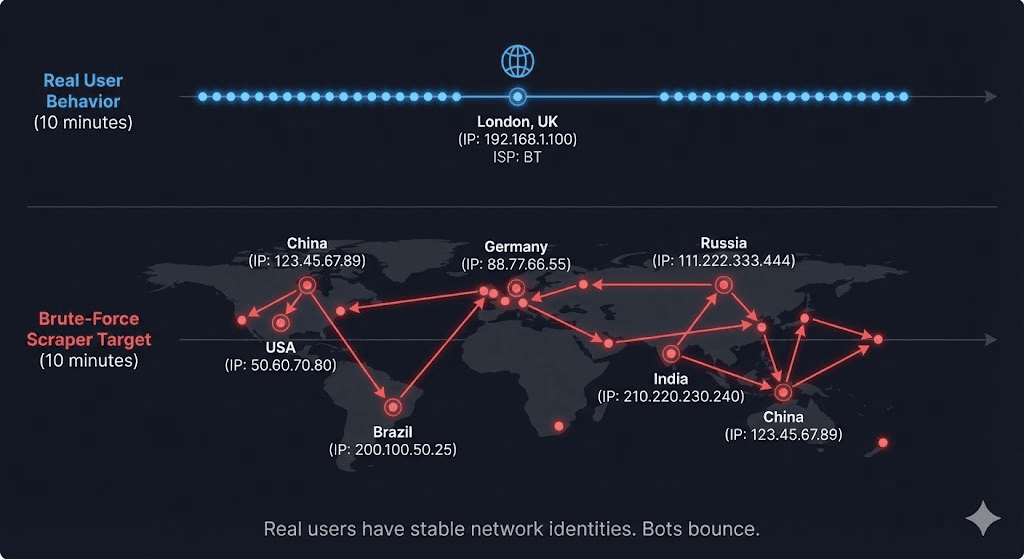
If every single request to a target site comes from a different IP, a different TLS fingerprint, and a different ASN, you don’t look stealthy. You look synthetic. You are creating a digital footprint that no real human could ever produce.

Visualizing the Problem

Imagine mapping the network requests of a real user versus a brute-force scraper over 10 minutes.
2. When Rotation Becomes a Red Flag (The Code View)

There are scenarios where aggressive rotation is effectively "suicide by infrastructure."

If you are scraping a site that requires a session, like a login, a shopping cart, or a multi-step search filter, rotating every request will break the continuity that the server expects.

The Wrong Way (Stateless Rotation on Stateful Target)

This Python snippet demonstrates a common mistake: trying to maintain a session while aggressively rotating the underlying network identity.

Python


In this scenario, rotation didn't help you avoid a block; it caused the block because the behavior was anomalous.

3. Strategy Shift: Deciding When to Rotate

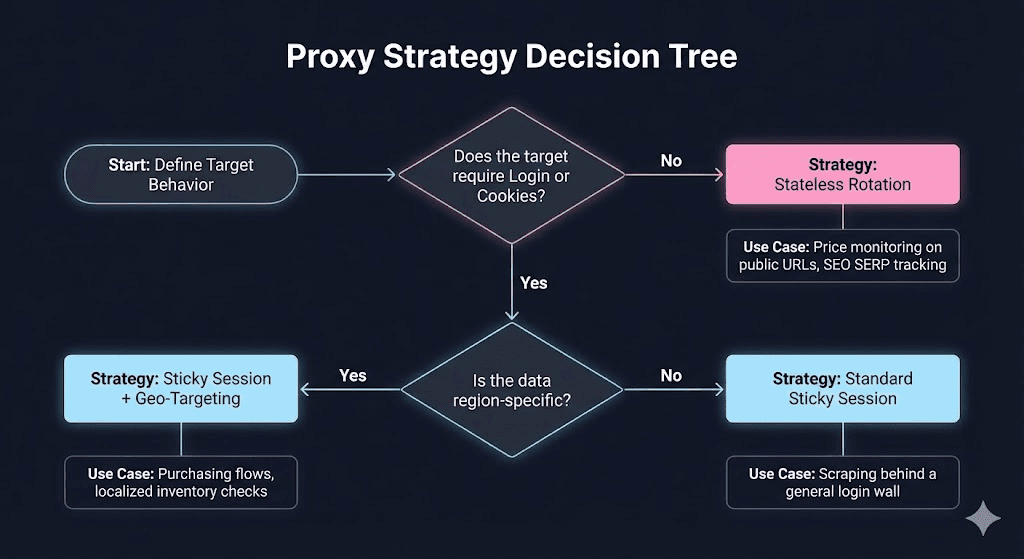
The real question isn’t if you should rotate, but how the target expects you to stick around. You need to choose between Stateless High-Availability and Session-Aware Persistence.

Here is a decision matrix for choosing your approach:
The Tale of Two Scrapers

In session-aware scraping, IP consistency is your best friend. Here, the quality and stability of the IP matter significantly more than the raw size of the proxy pool.

Feature

Stateless Scraping

Session-Aware Scraping

IP Strategy

High-frequency rotation (New IP per request)

Sticky Sessions (Keep IP for 10-30 mins)

Goal

Maximize request volume / second

Maintain a stable identity

Common Failure

Rate Limiting (429s)

Behavioral flagging / Session invalidation

Ideal Proxy Type

Datacenter or high-churn Residential

Stable Residential or ISP (Static Resi)

4. The Impact on Success Rates Over Time

Why do providers like Evomi emphasize "stateful assets" over massive, churning pools? Because stability pays off in the long run.

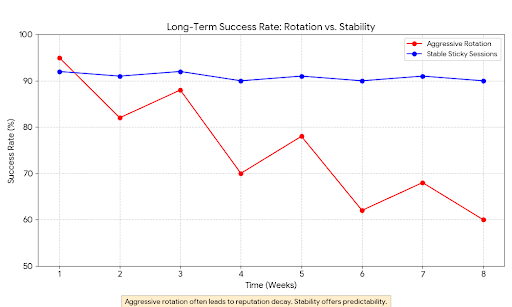
When you rely on aggressive rotation, your success rate often starts high but degrades quickly as your pool gets burned or your behavior gets flagged. When you use sticky, clean IPs aligned with user behavior, your success rate remains predictable.
The Takeaway

If your scraping strategy relies solely on rotation to stay alive, you aren't building a system, you're just gambling with your block rate.

The teams that win in production don't ask, "How often should we rotate?" They ask, "What behavior does this site actually expect?"

Stop treating proxies as disposable masks. Start treating them as the foundation of your scraper’s identity.

References & Further Reading

In the world of web scraping, "rotate your IPs" has become the universal troubleshooting advice. Getting blocked? Rotate. Seeing CAPTCHAs? Rotate faster. Data looks weird? Rotate harder.

The assumption is that if you change your digital "face" often enough, you become invisible.

In reality, proxy rotation isn’t a strategy, it’s a tool. And when you use a hammer to perform surgery, you shouldn't be surprised when the patient doesn't make it.

1. The "Synthetic User" Footprint

Modern anti-bot systems have moved past simple IP counting. They don’t just look at who you are (your IP address); they look at how you behave across time.

If every single request to a target site comes from a different IP, a different TLS fingerprint, and a different ASN, you don’t look stealthy. You look synthetic. You are creating a digital footprint that no real human could ever produce.

Visualizing the Problem

Imagine mapping the network requests of a real user versus a brute-force scraper over 10 minutes.

2. When Rotation Becomes a Red Flag (The Code View)

There are scenarios where aggressive rotation is effectively "suicide by infrastructure."

If you are scraping a site that requires a session, like a login, a shopping cart, or a multi-step search filter, rotating every request will break the continuity that the server expects.

The Wrong Way (Stateless Rotation on Stateful Target)

This Python snippet demonstrates a common mistake: trying to maintain a session while aggressively rotating the underlying network identity.

Python


In this scenario, rotation didn't help you avoid a block; it caused the block because the behavior was anomalous.

3. Strategy Shift: Deciding When to Rotate

The real question isn’t if you should rotate, but how the target expects you to stick around. You need to choose between Stateless High-Availability and Session-Aware Persistence.

Here is a decision matrix for choosing your approach:

The Tale of Two Scrapers

In session-aware scraping, IP consistency is your best friend. Here, the quality and stability of the IP matter significantly more than the raw size of the proxy pool.

Feature

Stateless Scraping

Session-Aware Scraping

IP Strategy

High-frequency rotation (New IP per request)

Sticky Sessions (Keep IP for 10-30 mins)

Goal

Maximize request volume / second

Maintain a stable identity

Common Failure

Rate Limiting (429s)

Behavioral flagging / Session invalidation

Ideal Proxy Type

Datacenter or high-churn Residential

Stable Residential or ISP (Static Resi)

4. The Impact on Success Rates Over Time

Why do providers like Evomi emphasize "stateful assets" over massive, churning pools? Because stability pays off in the long run.

When you rely on aggressive rotation, your success rate often starts high but degrades quickly as your pool gets burned or your behavior gets flagged. When you use sticky, clean IPs aligned with user behavior, your success rate remains predictable.

The Takeaway

If your scraping strategy relies solely on rotation to stay alive, you aren't building a system, you're just gambling with your block rate.

The teams that win in production don't ask, "How often should we rotate?" They ask, "What behavior does this site actually expect?"

Stop treating proxies as disposable masks. Start treating them as the foundation of your scraper’s identity.

References & Further Reading

In the world of web scraping, "rotate your IPs" has become the universal troubleshooting advice. Getting blocked? Rotate. Seeing CAPTCHAs? Rotate faster. Data looks weird? Rotate harder.

The assumption is that if you change your digital "face" often enough, you become invisible.

In reality, proxy rotation isn’t a strategy, it’s a tool. And when you use a hammer to perform surgery, you shouldn't be surprised when the patient doesn't make it.

1. The "Synthetic User" Footprint

Modern anti-bot systems have moved past simple IP counting. They don’t just look at who you are (your IP address); they look at how you behave across time.

If every single request to a target site comes from a different IP, a different TLS fingerprint, and a different ASN, you don’t look stealthy. You look synthetic. You are creating a digital footprint that no real human could ever produce.

Visualizing the Problem

Imagine mapping the network requests of a real user versus a brute-force scraper over 10 minutes.

2. When Rotation Becomes a Red Flag (The Code View)

There are scenarios where aggressive rotation is effectively "suicide by infrastructure."

If you are scraping a site that requires a session, like a login, a shopping cart, or a multi-step search filter, rotating every request will break the continuity that the server expects.

The Wrong Way (Stateless Rotation on Stateful Target)

This Python snippet demonstrates a common mistake: trying to maintain a session while aggressively rotating the underlying network identity.

Python


In this scenario, rotation didn't help you avoid a block; it caused the block because the behavior was anomalous.

3. Strategy Shift: Deciding When to Rotate

The real question isn’t if you should rotate, but how the target expects you to stick around. You need to choose between Stateless High-Availability and Session-Aware Persistence.

Here is a decision matrix for choosing your approach:

The Tale of Two Scrapers

In session-aware scraping, IP consistency is your best friend. Here, the quality and stability of the IP matter significantly more than the raw size of the proxy pool.

Feature

Stateless Scraping

Session-Aware Scraping

IP Strategy

High-frequency rotation (New IP per request)

Sticky Sessions (Keep IP for 10-30 mins)

Goal

Maximize request volume / second

Maintain a stable identity

Common Failure

Rate Limiting (429s)

Behavioral flagging / Session invalidation

Ideal Proxy Type

Datacenter or high-churn Residential

Stable Residential or ISP (Static Resi)

4. The Impact on Success Rates Over Time

Why do providers like Evomi emphasize "stateful assets" over massive, churning pools? Because stability pays off in the long run.

When you rely on aggressive rotation, your success rate often starts high but degrades quickly as your pool gets burned or your behavior gets flagged. When you use sticky, clean IPs aligned with user behavior, your success rate remains predictable.

The Takeaway

If your scraping strategy relies solely on rotation to stay alive, you aren't building a system, you're just gambling with your block rate.

The teams that win in production don't ask, "How often should we rotate?" They ask, "What behavior does this site actually expect?"

Stop treating proxies as disposable masks. Start treating them as the foundation of your scraper’s identity.

References & Further Reading

Author

The Scraper

Engineer and Webscraping Specialist

About Author

The Scraper is a software engineer and web scraping specialist, focused on building production-grade data extraction systems. His work centers on large-scale crawling, anti-bot evasion, proxy infrastructure, and browser automation. He writes about real-world scraping failures, silent data corruption, and systems that operate at scale.

Like this article? Share it.
You asked, we answer - Users questions:

In This Article