
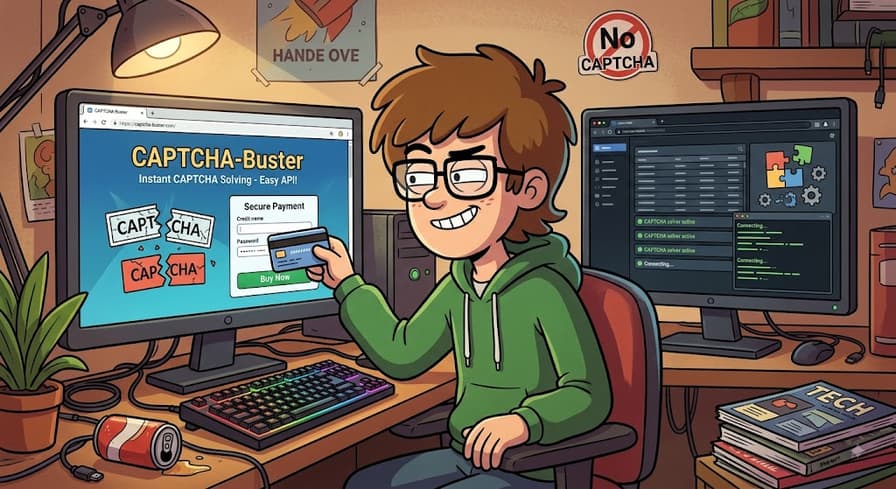
Step seven of the tutorial is two lines long. Sign up for a solving service, paste the API key into your config, and the CAPTCHA stops being your problem. There's an SDK on PyPI, a dashboard with a balance on it, and a price quoted per thousand solves. The whole thing reads like adding a payment processor.
What the docs never describe is what happens between your API call and the answer coming back. For most of the last fifteen years, the answer was a person, paid a fraction of a cent to look at your challenge image and type what they saw, usually within ten seconds, usually thousands of kilometres away.
That's an unusual supply chain to depend on and never mention. This post is about the market: how it worked, who it paid, what it enabled downstream, and why it's being automated out of existence. It is not a guide to using one, and it names no services.
Two Eras, Two Very Different Objections
The industry splits cleanly in half, and the criticisms of each half are near opposites.
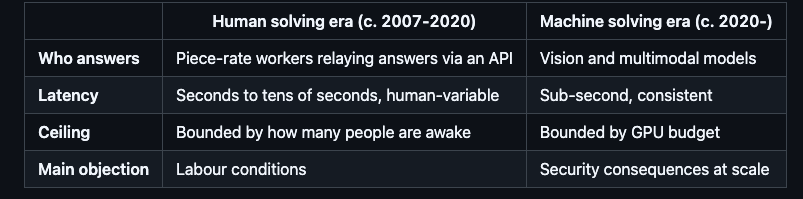
The second era removed the labour problem by removing the labourers. It made the security problem considerably worse.
How Human Relay Actually Worked
The mechanism was never sophisticated. The client captured the puzzle, typically the image, base64-encoded, and posted it to a solving network's API, which returned a task ID. The network pushed the task to a worker in a browser-based queue, the worker typed an answer, and it came back against the task ID. Elapsed time: a handful of seconds.
The important word is relay. Nothing was broken cryptographically and no model was trained. The challenge was forwarded to a human who was, in the narrow sense the CAPTCHA cared about, genuinely human. A test asking "is there a person here?" answers honestly if you rent a person.
The academic baseline for the economics is still the 2010 USENIX Security paper by Motoyama et al., Re: CAPTCHAs, Understanding CAPTCHA-Solving Services in an Economic Context. Its framing has aged better than any of the technology: a CAPTCHA is not a wall, it's a price, and it holds only while a solution costs more than the thing behind it is worth. At roughly a dollar per thousand solves — the retail figure their measurements landed on — that condition failed for almost everything on the web.
The Labour Question
This is the part that gets skipped, so be concrete about the spread. F5 Labs' write-up on human solver networks puts retail pricing at one to three dollars per thousand correct solutions, with workers receiving roughly forty cents per thousand, earnings it characterises as two to five dollars a day. It describes a workforce across 26 countries, close to three quarters of it in Venezuela, Indonesia or Vietnam as of May 2020. Vendor-published figures, not an independent audit; treat them as an order of magnitude.
The shape survives that imprecision. Most of the price is margin, and the work is piece-rate with no floor, paid per correct solve, which pushes the risk of an ambiguous or unsolvable image onto the person looking at it.
None of that means the workers were coerced. For many it was real income where the alternatives were worse, and the moralising tone that usually attaches to this subject isn't useful. But sit with the arrangement on its own terms: an entire class of control called human verification was defeated for over a decade by buying human attention at a rate that only works if you value it at almost nothing. The control and the workaround were made of the same material. The workaround just priced it lower.
And the buyer never saw any of it, which is the actual complaint about the docs. A dependency routing through a global piece-rate labour market deserves more than a config key.
Then the Machines Got Better Than Us
The human layer is being disintermediated, and the evidence is not subtle.
The most-cited data point is the USENIX Security 2023 study by Searles et al., which ran roughly 14,000 CAPTCHA solves across about 1,400 participants and compared them against automated solvers. Bots outperformed humans on both speed and accuracy across a wide range of CAPTCHA types, reported accuracy in the 85-100% band for solvers against roughly 50-85% for people. On reCAPTCHA image grids, humans scored around 81% and machines around 85%.
In 2024, Plesner, Vontobel and Wattenhofer at ETH Zurich published Breaking reCAPTCHAv2, reporting a 100% solve rate on the image challenges using off-the-shelf YOLO segmentation models, against 68-71% for prior published work. Their secondary finding matters more: they concluded reCAPTCHA v2 leans heavily on cookies and browser history when deciding whether you're human, meaning the visible puzzle was, by then, not where the decision was being made.
Read those two papers together and the visual CAPTCHA is finished as a classifier. It no longer separates the populations it was built to separate; if anything it favours the wrong one.
Why This Isn't a Victimless Market
It would be easy to file solver services under "grubby but harmless", and that's wrong. Cheap, reliable solving is the enabling condition for a set of harms sharing one property: they only work at volume.
- Credential stuffing. A list of leaked username/password pairs is worthless if you can only test a hundred an hour. The CAPTCHA on the login form is the rate limiter.
- Mass account creation. Spam, fraud, review manipulation and platform abuse are a numbers game, and signup CAPTCHAs are the numbers control.
- Ticket and inventory scalping. Purchase limits and checkout challenges exist to stop one buyer taking the whole allocation.
That last one has already produced enforcement. When the US Federal Trade Commission brought its first cases under the Better Online Ticket Sales (BOTS) Act in January 2021 against three ticket brokers, the proposed orders explicitly barred the defendants from using "CAPTCHA bypass services", alongside bots, fictitious identities and simultaneous IP addresses. The judgment was over $31 million in civil penalties, largely suspended on inability to pay. A regulator named solver services as part of the conduct, in public, five years ago.
The Cost Asymmetry, and Who Actually Pays
Here's the tradeoff analysis that explains why the industry is walking away. Treat it as a stated model, not a measurement: a visual CAPTCHA on a signup form, one funded attacker attempting 100,000 signups, and 100,000 genuine ones.

The Searles study also reported that around 30% of human participants abandoned before completing the CAPTCHA. Whatever that number is on your own funnel, the direction is fixed: the puzzle is a budgeted line item for the attacker and an unpriced tax on everyone else. That's before accessibility, where WCAG requires alternatives for non-text content and the audio fallback has been the weakest link in every visual CAPTCHA ever shipped.
A control that costs the attacker cents and the defender's own customers hours is not a control. It's a transfer.
Which Is Exactly Why the Industry Left
Vendors did this math before you did, and it's why CAPTCHAs are vanishing from the checkout flows you use. The response was to stop asking the client to do something and start asking it to present something, or to say nothing and infer. That's the move toward cryptographic attestation and behavioural signal collection covered in the earlier post on hCaptcha and Privacy Pass, and the four-way split between JS challenges, proof of work, interactive puzzles and attestation covered in the challenge taxonomy post. Neither can be relayed to a worker in a queue, because neither is a question a human knows the answer to.
The solver industry didn't lose an arms race. It won so completely that the game got replaced.
The Legal Exposure, Stated Plainly
This isn't legal advice and the position varies by jurisdiction, but the risk is worth naming. Scraping publicly available data is not, by itself, a computer-crime offence in the US, that's the direction of travel from Van Buren and the hiQ line of cases. Routing around a technical access control is a materially different posture from reading a public page. It bears on the "authorisation" question directly, and it interacts with terms-of-service contract claims and with statutes like the BOTS Act.
There's also an exposure that has nothing to do with statutes. A solver invoice is a document: discoverable, dated, tying volumes to timestamps, showing that someone knew a control existed and paid to get past it. In front of a court, a regulator, an acquirer's diligence team or your own security review, "we scraped it because it was public" holds up right until that billing history lands next to it.
What People Get Wrong
- "It's just an API, like any other dependency." It's a supply chain that historically routed through piece-rate human labour and now routes through models trained to defeat a security control. Neither is neutral.
- "CAPTCHAs stop bots." They stopped unfunded bots for about a decade. Against anyone with a budget they've been a line item, not a barrier, since roughly 2010.
- "Machine solving made it ethical." It removed the labour objection and amplified the security one. Volume up, latency down, marginal cost of abuse lower.
- "The site would have said no if it minded." The CAPTCHA is the site saying no, a boundary stated in the only vocabulary the web gives an origin.
- "Everyone does it, so it's normalised." Normalised inside scraping tutorials is not the same as normalised.
What Actually Survives Scrutiny
If you need data behind a challenge and you need the answer to hold up in a review, the list is short and boring:
- The official API. Frequently exists, frequently free at the volumes you actually need, and cheaper than the engineering you were about to do.
- A licence or data agreement. Many sites will sell you access. Asking costs an email.
- Bulk exports and dumps. Wikis, forges and government registries often publish the whole thing precisely so you don't crawl it.
- Public datasets. Common Crawl and domain-specific archives already hold much of what people build crawlers to re-fetch.
- Partnership. If the data is central to your business, a relationship with the source outlasts any scraper.
Each gives you something a solver never will: provenance you can put in a document, and a supply that doesn't break the next time a vendor ships a change.
Wrapping Up
The CAPTCHA solving industry is security's clearest example of a control that was priced rather than broken. For over a decade it was defeated by renting human attention at a few hundredths of a cent a go, an uncomfortable thing to learn about a mechanism called human verification. Now it's defeated by models measurably better at the task than we are. Both eras land on the conclusion vendors have already acted on: a visual puzzle taxes your legitimate users, excludes some of them entirely, and barely registers on the budget of anyone intending harm. If you hit one in your own pipeline, the useful reading isn't "what does it cost to get past this", it's that the site drew a line, and the options still defensible in five years all involve the front door.