


When you buy a residential proxy, your scraper's traffic leaves the internet from a real home internet connection, a phone on someone's couch, a laptop on a home Wi-Fi network, a smart TV in a living room in Berlin or Ohio. The target site sees that household's IP, not yours and not a server's.
Which raises a question most people skip past: whose connection is that, and how did the proxy provider get the right to send your requests through it?
That question is the whole story. The answer determines whether the network is fast, whether the IPs pass reputation checks, what you pay, and whether you're routing your traffic through devices whose owners actually agreed to it. This post explains how these networks are built, from the IP up.
What Makes an IP "Residential"
Every IP address belongs to an Autonomous System, a block of addresses controlled by one organization, identified by an ASN. When you look up an IP, you can see who that organization is.
A datacenter IP resolves to a hosting company: Amazon AWS, Google Cloud, OVH, Hetzner. A residential IP resolves to a consumer internet service provider: Comcast, Vodafone, Deutsche Telekom, Spectrum. That single fact is the entire reason residential proxies exist.
Anti-bot systems and reputation databases score IPs partly by ASN. An IP from a known cloud provider gets a worse score by default, because almost no ordinary humans browse from AWS, but bots and scrapers do, in bulk. So a request from a datacenter range starts the interaction already suspect, sometimes blocked before the first byte of HTML.
A residential IP carries the reputation of a real household behind a real ISP. It looks like a person at home because, physically, that's exactly where it is. That's why residential IPs clear checks that datacenter IPs trip, not magic, just a more plausible origin.
How the Pool Gets Sourced
A provider needs thousands or millions of these home IPs, and it doesn't own a single one of them, the ISPs assigned them to households. So the provider has to borrow access to those devices. The dominant mechanism is the SDK partnership.
A developer building, say, a free VPN, an ad-blocker, or a mobile game integrates the provider's SDK into their app. In exchange, the developer gets paid or unlocks a free tier for their users. The SDK turns the user's device into a potential exit peer, when it's idle and online, it can relay a small amount of someone else's traffic. The user, ideally, agreed to this in a clear opt-in screen ("use the app for free in exchange for sharing some bandwidth"), and can opt back out.
There are also direct rewards programs, where a person installs an app specifically to earn money or credit by sharing their unused bandwidth. Same idea, more explicit consent.
Once a device is in the pool, here's the path your request takes:
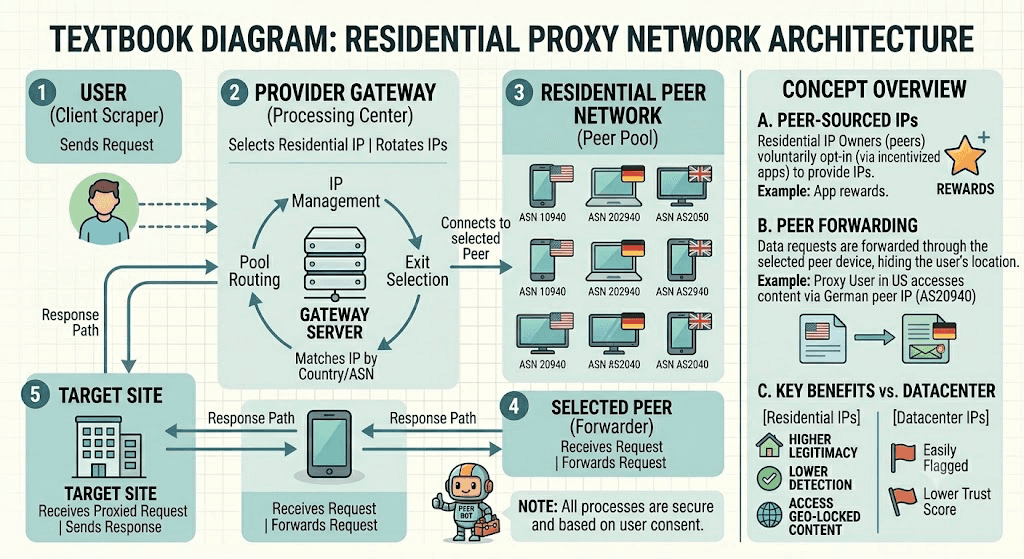
You never talk to the peer directly. You send your request to one stable endpoint — the gateway — with credentials and targeting parameters. The gateway picks an eligible exit peer, forwards your request out through that home connection, receives the response, and hands it back to you. The peer device is the part the target actually sees.
The Ethics Spectrum, Plainly
This sourcing model can be done cleanly or it can be done badly, and the difference matters more than any feature comparison.
Clean end: properly consented opt-in SDKs and rewards programs. The user is told, in plain language, that their device will relay traffic; they agree; they can leave. Only idle, owner-consenting devices participate.
Murky middle: consent buried in a wall of legalese, no real opt-out, bandwidth shared whether the user understands it or not.
Dirty end: IPs harvested through malware, hidden bundling in pirated software, or SDKs that quietly turn a device into an exit node without the owner ever knowing. The "peer" here is a compromised device, and routing your traffic through it makes you a downstream beneficiary of that.
"Ethically sourced" should mean something specific, not a marketing word: informed consent (the user genuinely understood and agreed), a working opt-out, and no compromised devices in the pool.
The other half of ethics lives on the buyer side. Reputable providers run KYC on their customers and vet use cases, they don't want their pool relaying credential-stuffing or other abuse, because that poisons the IPs for everyone and exposes the unwitting peers to real harm. A provider that sells to anyone with a credit card and asks no questions is telling you something about how it treats the people on both ends of the connection.
The Mechanics That Follow From Real Devices
Because exit peers are actual home devices and not servers in a rack, the behavior of a residential network falls out of physics and human habits:
Variable latency. A peer might be a fast fiber connection or a phone on weak mobile data. You can't assume datacenter-grade speed. Round trips swing.
Devices go offline. People close apps, leave Wi-Fi, go to sleep. A peer that was available a minute ago can vanish mid-session. This is why rotation exists and why "sticky" sessions have time limits, the provider can only hold a given peer for as long as it stays online.
Bandwidth-based pricing. You almost always pay per GB, not per IP or per request. The reason is direct: you're consuming a real person's home bandwidth, and the peer (or the app developer) is compensated based on data moved. The cost structure mirrors the resource you're actually borrowing.
None of this is a flaw. It's the honest shape of routing through real connections instead of fake ones.
Rotating vs Sticky, and Targeting
The gateway is where you control behavior, usually through the username string or a port convention.
Rotating sessions give you a different exit peer on (roughly) every request. Good for spreading high-volume crawls across many IPs so no single household IP gets hammered.
Sticky sessions pin you to the same exit peer for a window, often up to a handful of minutes, bounded by how long that device stays online. Use these when you need a stable IP across a multi-step flow, like logging in and paging through results.
Geo and ASN targeting also happen at the gateway. You ask for a country, sometimes a city, sometimes a specific carrier ASN, and the gateway filters the pool to peers matching that criterion before picking one. City-level and ASN-level targeting depend on the pool actually having enough peers in that location, coverage, not a switch.
Residential vs ISP vs Datacenter vs Mobile
Four common types, in plain terms:
Datacenter: IPs from hosting providers. Fast, cheap, abundant, but the ASN gives them away, so they fail reputation checks on protected sites. Great for unprotected targets and APIs.
Residential: peer-sourced home IPs as described above. High trust, broad geo coverage, per-GB pricing, variable speed, IPs rotate as peers go offline.
ISP (static residential): IPs registered to a consumer ISP but hosted in a datacenter. You get the residential ASN reputation and server-grade stability and speed, on a static IP you keep. The middle ground, usually priced per IP.
Mobile: IPs from cellular carriers (4G/5G). The highest-trust tier because carrier-grade NAT means thousands of real users share each IP, so blocking one is costly for the site. Also the most expensive, and the slowest and most variable.
How to Evaluate a Provider Honestly
Most provider pages list pool size and speed. The questions that actually separate a clean network from a sketchy one are about sourcing and conduct:
Where do the IPs come from? A straight answer names the model, opt-in SDKs, rewards apps, partnerships. Evasiveness here is the single biggest red flag.
Can they show opt-in proof? Ask how peers consent and how they opt out. A provider running a transparent, ethically-sourced model, Evomi is one example, can describe the consent flow without hand-waving.
Pool size and freshness. Raw IP count is a vanity number; what matters is how many peers are online and clean in the countries you need, and how often the pool refreshes.
Compliance posture. Do they run KYC on buyers? Do they vet use cases and refuse abusive ones? Are they GDPR/CCPA-aware? This protects the peers, and it protects you from sharing a pool with bad actors.
If a provider won't answer question 1 clearly, you can stop there.
Wrapping Up
A residential proxy is someone's real home IP, borrowed through their device, that one fact explains the trust (real ISP ASN), the price (per GB, because you're using their bandwidth), and the quirks (variable latency, peers dropping offline). Everything else is the gateway doing rotation and targeting on top.
The decision that matters most isn't rotating versus sticky or which country list is longest. It's whether the people whose connections you're using actually agreed to it. Pick a provider that can answer "where do the IPs come from" in one honest sentence, and the rest tends to be honest too.